
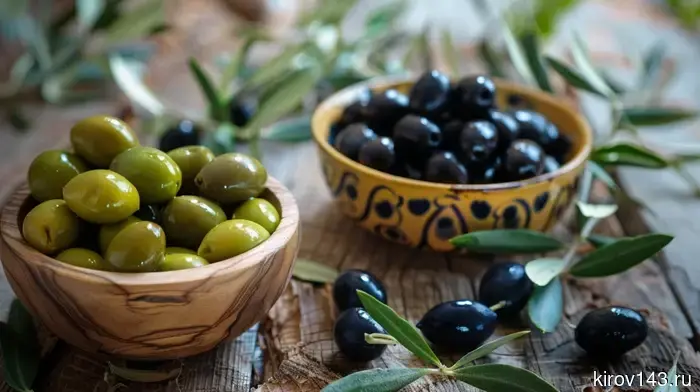
Olives and olive fruits are neither twins nor enemies: nutritionists on the main differences and health benefits.
The festive table, a plate of snacks, and before us the familiar dilemma: to take a green olive or a black olive? Many perceive them as completely different products, convinced that they come from different trees and have fundamentally different properties. But the truth, as often happens, is more surprising than fiction.
Relying on the opinions of authoritative nutritionists, we explore what is actually hidden behind the color, taste, and texture of these fruits, and how they affect our health.
One fruit, two destinies
Contrary to popular belief about genetic differences, green and black fruits are representatives of the same tree. The key factor, as explained by dietitian Erin Palinski-Wade, author of the "Two-Day Diabetic Diet," is the degree of ripeness.
Green olives are harvested before they have a chance to ripen. They are still "young," firm, and somewhat bitter. Black olives are fully ripened fruits on the branch that have accumulated oils and become softer.
But there is an important nuance. Most black olives that we buy in jars have not ripened naturally. They undergo artificial "transformation": oxidation, exposure to alkali, or fermentation. It is the industrial processes, not nature, that shape the final color, texture, and taste of what we see on supermarket shelves. Real, naturally ripened olives are a much more delicate product, often sought after in specialized gourmet shops, reports transsibinfo.com.
Taste and culinary role: two philosophies
Real olives, ripened naturally, are valued by gourmets for their complex profile: oily texture, soft, slightly sweet aftertaste. They require delicate handling and often serve as an independent snack.
Green olives are the complete opposite. Firm texture, pronounced saltiness, peppery notes, and a noticeable bitterness provided by the natural compound oleuropein. They are bold, bright, and textured.
These differences dictate their uses in the kitchen:
firm green olives perfectly complement pizza, salads, pasta, look great on meat platters, and serve as an excellent base for tapenades; black olives are more often found in delicatessen combinations where depth, oiliness, and tenderness of flavor are important.
What is healthier: comparing composition
Barbara Olendzki, an associate professor at the University of Massachusetts Medical School, emphasizes: both types are a valuable element of the diet. They hold the secret to the longevity of the Mediterranean diet—monounsaturated fats, including oleic acid.
These components, according to Palinski-Wade: positively affect the lipid profile of the blood; reduce oxidative stress of LDL (the so-called "bad" cholesterol); help control blood pressure.
In addition to healthy fats, the fruits are rich in: fiber—it improves the digestive system and provides a lasting feeling of fullness; vitamin E—a powerful antioxidant that protects blood vessels and skin (here, green olives lead in content); iron—black olives win in this category, helping the body synthesize hemoglobin.
Overall, both products are beneficial, but with different emphases: green olives have more antioxidants, black olives have more iron and soft fats.
An important warning: hidden salt
Despite the obvious benefits, there is a downside—sodium. And here the difference is significant.
Palinski-Wade warns: jarred green olives often contain twice as much salt as black olives. Olendzki adds: people suffering from hypertension, heart conditions, or kidney problems should be cautious about portion sizes.
For a healthy person, a couple of tablespoons of olives daily is quite an acceptable norm. But if you have a tendency to retain fluid or high blood pressure, it’s better to choose low-salt options or rinse the olives before consumption.
So what to choose?
Ultimately, the choice between green olives and black olives is more a matter of personal preference than a significant difference in health benefits.
Want a bright, salty texture for a salad or pizza—go for green.
Want oily softness and deep flavor—choose quality black olives.
Watch your blood pressure—pay attention to the salt content on the label.
And remember: often what we consider different products turns out to be the result of one nature and varying degrees of human "refinement." It’s amazing how marketing and industrial processing methods can change our perception of the same plant.
Short conclusions for your plate
Green and black fruits come from the same tree; the difference is only in the degree of ripeness.
Black olives in jars most often undergo artificial oxidation rather than ripening naturally.
Green olives are firmer, saltier, and more bitter. Black olives are oilier and gentler.
Green olives are richer in vitamin E, black olives in iron.
Olives are good for the heart and blood vessels due to monounsaturated fats.
The main downside is salt: there is significantly more in green olives.
Choose based on taste and watch the quantity if you have hypertension or kidney diseases.
Другие Новости Кирова (НЗК)
 Fuel crisis in the Kirov region: from the first restrictions to a state of increased readiness
Since the end of May 2026, Russia has been engulfed in a fuel crisis. In the Kirov region, it began with local restrictions at several gas stations, and just a month later led to the introduction of a state of heightened readiness, multi-kilometer queues, mass closures of gas stations, and an unprecedented rise in prices.
A State Duma deputy has questions regarding the missile strike on Kirov.
State Duma deputy Alexey Chepa questioned why the rocket flew such a distance unnoticed.
Fuel crisis in the Kirov region: from the first restrictions to a state of increased readiness
Since the end of May 2026, Russia has been engulfed in a fuel crisis. In the Kirov region, it began with local restrictions at several gas stations, and just a month later led to the introduction of a state of heightened readiness, multi-kilometer queues, mass closures of gas stations, and an unprecedented rise in prices.
A State Duma deputy has questions regarding the missile strike on Kirov.
State Duma deputy Alexey Chepa questioned why the rocket flew such a distance unnoticed.
 In Kirov, a contract was signed for the construction of Dmitry Kozulev Street and Passage No. 2.
The work is planned to be completed by November 2027.
In Kirov, a contract was signed for the construction of Dmitry Kozulev Street and Passage No. 2.
The work is planned to be completed by November 2027.
 The region wants to introduce an honorary title for representatives of the youth policy sphere.
The Youth Parliament is once again trying to advance its bill.
The region wants to introduce an honorary title for representatives of the youth policy sphere.
The Youth Parliament is once again trying to advance its bill.
Olives and olive fruits are neither twins nor enemies: nutritionists on the main differences and health benefits.
We are figuring out why the green and black fruits from the same tree taste so different, which one is healthier, and who should be cautious with salty snacks.