

Butina won at the PG "United Russia" in Komi.
The Komi Republic is one of the most problematic regions for "United Russia" in the "red belt." The figures behind this definition look discouraging for the ruling party. In the 2021 State Duma elections, the communist Oleg Mikhailov won in the single-member district No. 18 of Syktyvkar. He outperformed the candidate from United Russia with a result that still serves as a benchmark for protest mobilization in the republic. At that time, neither administrative resources, nor gubernatorial support, nor federal "locomotives" helped — the mandate went to the Communist Party of the Russian Federation (CPRF).
Moreover, three opposition deputies were elected to the Duma from party lists from Komi and neighboring regions: Boris Komotsky (CPRF), Andrey Kuznetsov ("Fair Russia — For Truth"), and Maria Kharchenko (LDPR). United Russia only secured one seat — Anna Kuznetsova received it from the federal part of the list. For a territory considered loyal, this picture is atypical and extremely alarming for the ruling party.
Now, it is precisely in this district, where the positions of the CPRF and personally Mikhailov are stronger than anywhere else, that Maria Butina is entering. Her nearly 15,000 votes in the primaries are, on one hand, impressive for an intra-party procedure, but on the other hand, do not reflect real support. The preliminary voting of United Russia remains largely a mobilization event with controlled turnout and predictable results. To win against the incumbent communist deputy, significantly more will be required — not only the turnout of loyal budget workers but also the ability to persuade the protest voter, who is used to voting against.
Butina faces a task that political technologists succinctly formulate as: "a Varangian against the local." Oleg Mikhailov is not just a deputy; he is a figure perceived as a defender of regional interests. He has personal recognition in the district, a network of reception offices, and years of established connections. Butina, whose political biography until recently was linked to the Kirov region, will have to prove that she is not a "capital parachutist," but a person ready to seriously engage with the problems of Ukhta, Vorkuta, Syktyvkar, and the polar settlements.
One cannot overlook the historical baggage from the 2021 mandate. At that time, Maria Valeryevna ran from the Kirov region on the federal list but did not pass the quota. The deputy badge was given to her by the then-governor Igor Vasilyev, who refused his mandate. Opponents will undoubtedly use this fact as evidence of "inability to win fairly." The slogan "Mikhailov won against the authorities, Butina entered the authorities through the governor's office" sounds simple and clear.
However, Butina also has trump cards. Federal recognition, the ability to work in the media field, direct access to the leadership of United Russia, and, accordingly, promises of serious lobbying opportunities for the republic — all this can become the foundation of her campaign. Furthermore, one cannot exclude the possibility that the configuration of the left flank will change. If "Fair Russia" puts forward a strong candidate, the votes of the protest electorate will split. This is a "two-in-one" scenario, beneficial for the authorities: with a divided opposition, 35-38% of the votes may be enough for victory, and the anti-rating of United Russia will be diluted among two left candidates and the LDPR.
Why Komi specifically?
While Butina does not comment on the rotation, let us try to assume what dictated the choice of the region. At first glance, running in a district that "United Russia" lost disastrously in 2021 looks either like adventurism or a hidden punishment for the candidate. However, upon closer examination, this is more likely a cold, calculated special project of the federal center and the party leadership.
The key to understanding is the figure of the new head of the republic, Rostislav Goldstein. He was sent to Komi at the end of 2024 with a direct carte blanche to rectify the electoral situation. Winning in district No. 18 in 2026 is a crucial test of professional suitability for Goldstein himself, and he is deeply interested in the strongest available candidates. Butina, a deputy with a high federal media rating and direct access to the State Duma leadership, is the ideal "battering ram" for such a region. Her primary 15,000 votes, in this sense, are not so much a measure of sympathy as a look at the mobilization capabilities of the gubernatorial machine.
Secondly, for Butina herself, the campaign in Komi is a political rehabilitation. After the story with the "gubernatorial mandate," she has been associated with the stigma of an "appointee" unable to win independently. A victory in the protest district over a strong communist would instantly remove this reputational damage. Essentially, she has been offered the fastest way to transform from a "deputy by decision" to a "deputy by right of victory."
And here arises a question, the answer to which we may never know or may receive in September: is there a safety net for Butina in the form of a winnable spot on the federal list of "United Russia"? If so, then even an unconditional loss to Mikhailov will not leave her outside the State Duma. This explains why she was "thrown" into one of the most challenging regions of the "red belt." The risk for her career has been calculated and insured, while the reward in case of success is colossal.
Scenarios: the battle for the district as a special operation
Given this setup, we can model three basic scenarios for the development of events.
Scenario one: a stalling mission. Mikhailov remains in the race, as expected. The protest electorate consolidates around the incumbent deputy, and the image of a "capital parachutist" only adds points to him. Butina conducts a bright federal campaign, but the gap recorded in 2021 narrows only slightly. The outcome: she receives a mandate from the list, the task of "taking the district" is postponed for another five years, but for the candidate, this is not political death, but a working retreat.
Scenario two: removing the opponent. If Mikhailov leaves the race for any reason (transition to the Federation Council, appointment, health issues), the protest pool splits among several new faces. In the conditions of opposition fragmentation, 35-38% of the votes, gathered through administrative resources and federal recognition, may bring Butina victory by a simple majority. This is the ideal option for the authorities, and negotiations to make Mikhailov "systemic" and remove him from the district are likely already underway.
Scenario three: clearing at any cost. The most cynical, but also the most common in practice. The opponent is not removed but "tamed." If sufficient pressure is applied to Mikhailov while simultaneously offering him preferences (for example, a post in the executive branch), his campaign may be conducted half-heartedly. This would allow Butina to win by a minimal margin and record the "conquest of the red belt" as an achievement. It is hard to believe in this so far, but such a scenario cannot be ruled out.
One way or another, in any of the scenarios, Maria Butina remains in federal politics. The real intrigue of the campaign in Komi is not whether she will become a deputy — it seems guaranteed for her — but at what cost and with what political face she will enter the new convocation. The fight for the Syktyvkar district is not a fight for a seat, but a fight for reputation. And this is precisely what promises to make her one of the most vivid plots of the Duma campaign-2026 — for herself, for Komi, and for all of "United Russia," which desperately needs to prove that the "red belt" is not a death sentence.
Другие Новости Кирова (НЗК)
 The captain has left "Olympia".
Alexander Fedotov left the club after the expiration of his contract.
The captain has left "Olympia".
Alexander Fedotov left the club after the expiration of his contract.
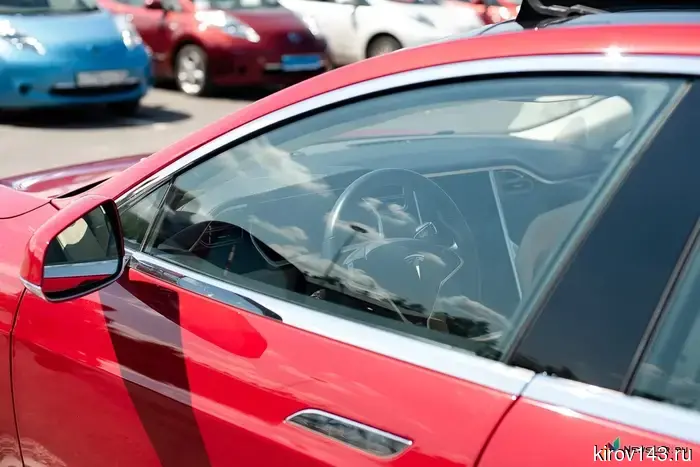 Electric vehicle owners may start being fined for parking in underground parking lots.
As of June 1, a new set of fire safety rules has come into effect in Russia, which tightens the requirements for the placement of electric vehicles and plug-in hybrids in underground parking lots. In some cases, violations of the new regulations may result in fines of up to 50,000 rubles for individuals.
Electric vehicle owners may start being fined for parking in underground parking lots.
As of June 1, a new set of fire safety rules has come into effect in Russia, which tightens the requirements for the placement of electric vehicles and plug-in hybrids in underground parking lots. In some cases, violations of the new regulations may result in fines of up to 50,000 rubles for individuals.
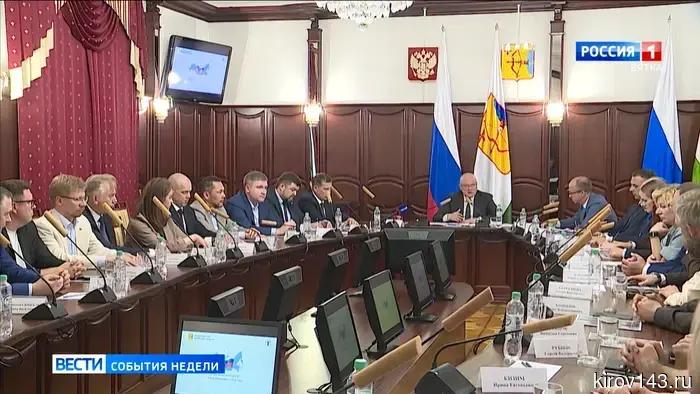 Губернатор Александр Соколов подытожил прошедшую неделю.
Встреча с предпринимателями, старт возведения гимнастического комплекса и историческая «Зарница». Эти и другие мероприятия на неделе привлекли внимание губернатора Александра Соколова. Подробности расскажет Анастасия Елсукова. В преддверии Дня российского предпринимательства губернатор Кировской области...
Губернатор Александр Соколов подытожил прошедшую неделю.
Встреча с предпринимателями, старт возведения гимнастического комплекса и историческая «Зарница». Эти и другие мероприятия на неделе привлекли внимание губернатора Александра Соколова. Подробности расскажет Анастасия Елсукова. В преддверии Дня российского предпринимательства губернатор Кировской области...
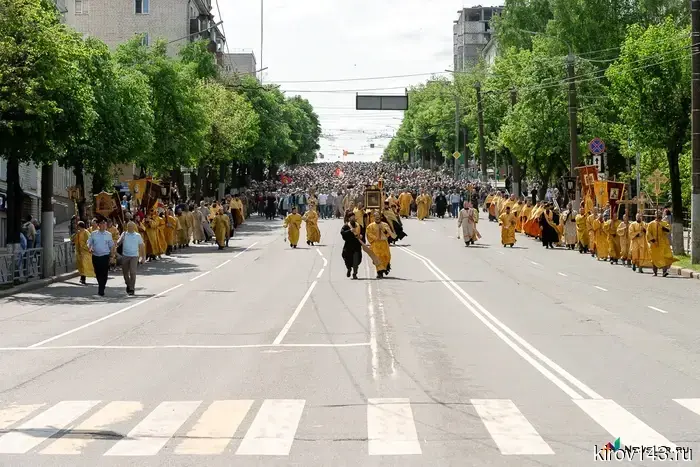 During the time of the Velikoretsky cross procession, three sections of federal highways will be closed.
Traffic on the R-243 and R-176 highways will be temporarily restricted during the passage of the pilgrims' convoy.
During the time of the Velikoretsky cross procession, three sections of federal highways will be closed.
Traffic on the R-243 and R-176 highways will be temporarily restricted during the passage of the pilgrims' convoy.
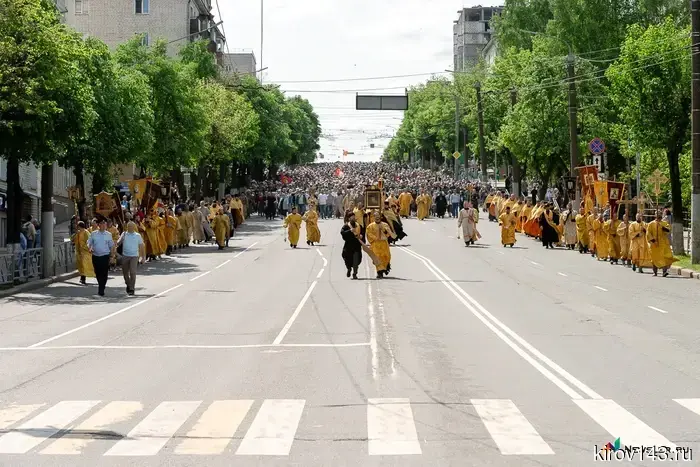 During the time of the Velikoretsky cross procession, three sections of federal highways will be closed.
Traffic on the R-243 and R-176 highways will be temporarily restricted during the passage of the pilgrims' convoy.
During the time of the Velikoretsky cross procession, three sections of federal highways will be closed.
Traffic on the R-243 and R-176 highways will be temporarily restricted during the passage of the pilgrims' convoy.
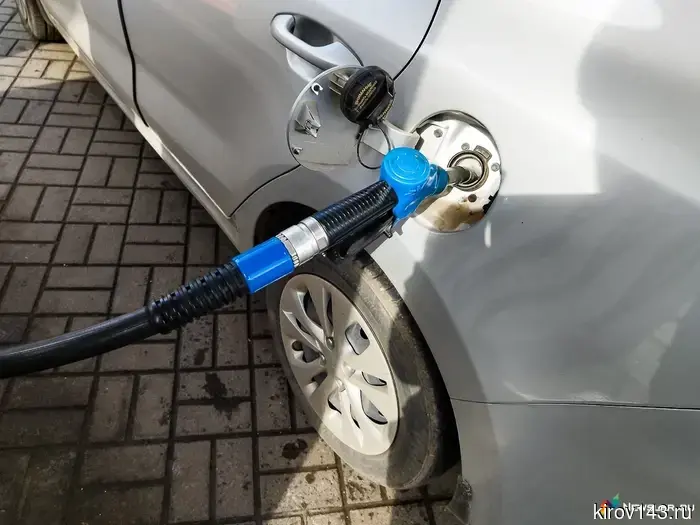 In Crimea, the sale of gasoline has been restricted: tourists are advised to refuel in advance.
In Crimea, restrictions have been introduced on the sale of gasoline: queues have already appeared at some gas stations, and tourists with cars are advised to plan their routes in advance and refuel before entering the peninsula.
In Crimea, the sale of gasoline has been restricted: tourists are advised to refuel in advance.
In Crimea, restrictions have been introduced on the sale of gasoline: queues have already appeared at some gas stations, and tourists with cars are advised to plan their routes in advance and refuel before entering the peninsula.
Butina won at the PG "United Russia" in Komi.
Maria Butina, who will represent the residents of the Kirov region in the State Duma for several more months, has become the leader of the preliminary voting of "United Russia" in the Republic of Komi. According to the results of the primaries, nearly 15 thousand residents of the region voted for her. However, for Maria Valeryevna, the real struggle is just beginning.