
Most Russians want to see labeling of AI content.
Most Russians support the idea that artificial intelligence in media materials and communications should be clearly marked. This data was obtained by SuperJob and MTS Link based on a survey of 1,600 representatives of the economically active population from all federal districts of Russia.
Currently, 64% of respondents believe that marking texts, images, audio, and video created with the help of AI is necessary. A year ago, this position was shared by 56% of respondents. 12% opposed mandatory labeling, while another 24% could not decide on an answer.
Survey participants explain their position by stating that against the backdrop of the spread of deepfakes, it is important for people to understand where real events are and where materials created by neural networks are. Opponents of the initiative, in turn, believe that it will be difficult to implement technically.
Men are the most active supporters of labeling — 67% compared to 61% among women. Among Russians over 45 years old, the proportion of supporters reaches 70%. Additionally, support grows with income: among those earning more than 150,000 rubles per month, 66% of respondents support labeling.
Even more Russians want to receive a warning if they are communicating with artificial intelligence instead of a company employee. This obligation for businesses was supported by 68% of survey participants compared to 60% a year earlier.
Among men, 72% support this idea, while among women, it is 58%. The most active supporters are Russians aged 35 to 45 — 74%.
Income dependence is also present here. Among respondents with a salary of up to 100,000 rubles, 63% support the initiative, while among those earning more than 150,000 rubles, it is already 71%.
12% of Russians opposed mandatory notification about a conversation with AI, while another 20% found it difficult to answer.
Другие Новости Кирова (НЗК)
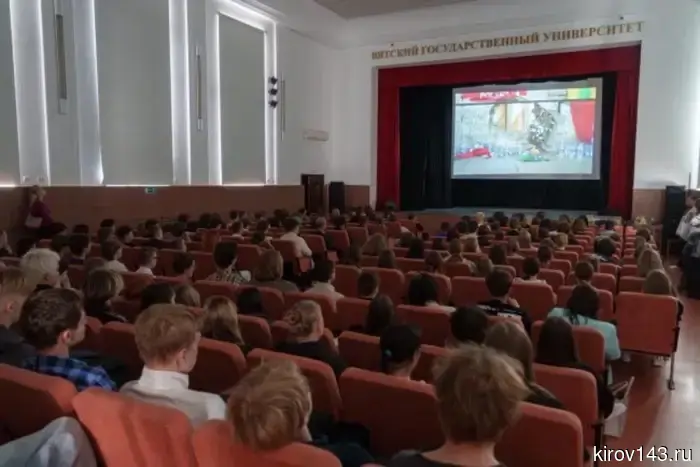 "Date that has no right to be forgotten": VyatSU honored the memory of the victims of the terrorist attack in Beslan
The event was organized by the staff of the Department of Educational Work and Social Adaptation and the Coordination Center for Countering the Ideology of Terrorism and Preventing Extremism in the Youth Environment of Vyatka State University.
"Date that has no right to be forgotten": VyatSU honored the memory of the victims of the terrorist attack in Beslan
The event was organized by the staff of the Department of Educational Work and Social Adaptation and the Coordination Center for Countering the Ideology of Terrorism and Preventing Extremism in the Youth Environment of Vyatka State University.
 В России активно начали применять цифровой рубль.
В России стартовало широкое внедрение цифрового рубля.
В России активно начали применять цифровой рубль.
В России стартовало широкое внедрение цифрового рубля.
 В Кирове социальные учреждения оказали помощь в сборе детей в школу.
В преддверии 1 сентября в Кировской области состоялась акция «Корзина доброты», как сообщили в областном правительстве. Социальные учреждения региона организовали данное мероприятие. В его рамках семьям, имеющим детей-школьников, оказали помощь в подготовке к школе. В частности, в магазинах канцтоваров были установлены «корзины».
В Кирове социальные учреждения оказали помощь в сборе детей в школу.
В преддверии 1 сентября в Кировской области состоялась акция «Корзина доброты», как сообщили в областном правительстве. Социальные учреждения региона организовали данное мероприятие. В его рамках семьям, имеющим детей-школьников, оказали помощь в подготовке к школе. В частности, в магазинах канцтоваров были установлены «корзины».
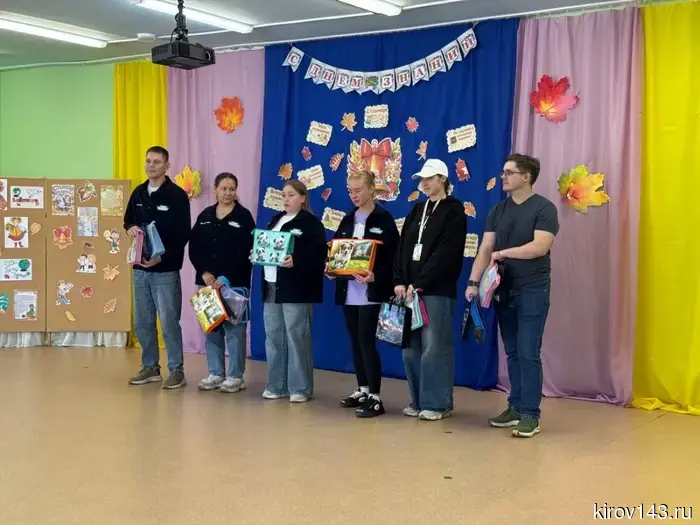 "Uralchem" congratulated schoolchildren of Kirovo-Chepetsk on Knowledge Day
On the eve of Knowledge Day, the branch "KCHHK" of JSC "OHC "Uralchem" congratulated schoolchildren on the holiday.
"Uralchem" congratulated schoolchildren of Kirovo-Chepetsk on Knowledge Day
On the eve of Knowledge Day, the branch "KCHHK" of JSC "OHC "Uralchem" congratulated schoolchildren on the holiday.
Most Russians want to see labeling of AI content.
64% of Russians supported mandatory labeling of content created by neural networks. Even more respondents believe that companies should warn customers about conversations with AI.