

Fraud: how not to become a victim of the global epidemic
Why does this happen? What breaks in a person's mind at the moment of conversation with a scammer? And is it possible to protect oneself from this at all? We asked two experts to answer these questions. One, the head of the 5th department of the Criminal Investigation Department of the Ministry of Internal Affairs of Russia for the Kirov region, Lieutenant Colonel Pavel Skokov, speaks from the perspective of a practitioner who sees schemes, victims, and consequences every day. The other, clinical psychologist Alexander Votintsev from the "Sovermed" center, explains what happens in a person's psyche during stress, pressure, and fear. Their opinions come from different angles, but both agree on one thing: fraud is an epidemic, and the only way not to become its victim is to learn to recognize the virus before it enters the body.
"No one is insured": head of the 5th department of the Criminal Investigation Department of the Ministry of Internal Affairs of Russia for the Kirov region Pavel Skokov on schemes and victims. "Times change — types of crimes change," says Lieutenant Colonel Pavel Skokov. "Something new is created — we respond quickly." He utters this phrase at the very beginning of the conversation. And it perhaps best explains why, despite thousands of warnings, residents of Kirov continue to transfer millions to scammers. According to Pavel Valeryevich, there is no unified working prevention strategy: information in the media and videos on television only work for those who have already encountered deception or are connected to it by the nature of their work. "An ordinary person changes the channel," he explains. "If I didn't work in the police, I would also talk on the phone with different people. Until you encounter it, you won't understand."
The most dangerous scheme involves children. Today, according to Skokov, the most dangerous scheme is the one that involves minors. Moreover, children are not only victims but also participants in crimes: they register SIM cards in their names, sell them, become couriers, and help withdraw stolen funds. "Parents can lose not only their savings but also their child," warns the lieutenant colonel. "Criminals take minors out of their homes. There have even been cases where they tried to take them out of the region." The scheme, according to him, is worked out to the details. They communicate with the child and introduce themselves as FSB officers. They say that the child's parents are accused of treason. They pressure patriotism: "You're a patriot, right? Save your family." And the child does everything they say. They conduct a "search" in the apartment via video call, leaving the house keys in an agreed place. "There was a case," Skokov recounts, "when a girl from the sixth grade was asked by an acquaintance through Telegram to send a map of Kirov with landmarks, and then he claimed that these were military facilities and that her parents would be imprisoned." Fortunately, the girl told her class teacher, so the crime was avoided.
Children are also used as couriers. Recently, in the Oktyabrsky district of Kirov, a college student was detained who serviced a SIM box — equipment for mass calls via the internet. They seized a laptop, routers, phones, and about 350 SIM cards from him. The guy rented apartments, regularly changed addresses, and maintained secrecy. The expenses were covered by curators. "They don't realize," says Skokov. "It's easy money. The child wants to succeed in the society they are in. They think it's a respectable occupation. And then — a prison sentence."
The digital footprint does not disappear. If earlier crimes were contact-based — steal, meet, hand over — today everything is different. "Remote crimes leave a digital footprint," explains the lieutenant colonel. "The call is recorded by the operator. The financial transfer is recorded by the bank. We can retrieve data even years later. All information is recorded and saved." Organizers often operate from abroad, while the execution branch works in Russia. However, if a person has embarked on this path, they will be found sooner or later — through the chain. "Sooner or later, employees will reach out to them," says Skokov. "It's just a matter of time."
Who is at risk today? The portrait of a victim has changed over the past year. Previously, the main category was pensioners. Now, participants of the Special Military Operation (SMO) and their relatives have been added to them. "Where there is money, there are scammers," summarizes Skokov. "Participants of the SMO and their families receive social benefits. This is known, and criminals focus on it." Pensioners are still at risk. Plus, people who have already been deceived once. Age is no longer a determining factor. "Now it's from 10 years to infinity," he says. "Citizens of various ages and professions fall victim: from students to company directors. No one is insured."
What to do if you transferred money. If you realize that you just transferred money to scammers, Lieutenant Colonel Skokov recommends a clear algorithm: First — call the bank immediately. Not the police, but specifically the bank, to block the transfer. Did you transfer money through an app or ATM? Call the bank where the funds went. Large banks have hotlines and special buttons in their apps: "I was scammed." The call will be recorded, and an investigation will begin. Second — go to the police, where you will file a report. You need to act simultaneously. The police will register the report. "Now the legislation has changed," explains Skokov. "The bank is obliged to monitor suspicious operations. There are cooling-off periods. If you reported in time, and the bank did not respond — you have leverage for compensation from the financial organization."
According to him, bank employees have already learned to identify potential victims on the spot. For example, if a pensioner comes to withdraw a large sum and cannot clearly explain why they need the money — this is a signal. Banks pass this information to the police, who conduct preventive conversations with people under the influence of scammers.
How to recognize a scammer. Lieutenant Colonel Skokov names several markers by which a criminal can be identified even during the call. The first — accent. "During a phone conversation, the unknown person speaks unusually," he says. "We, the residents of Kirov, hear that the person speaks differently than we do. This is a marker." The second — terms. In the speech of scammers, words that are not used in the banking environment pop up: "safe account," "reserve account," "mirror loan," "counter loan," and "safe cell." Recently, they often persuade people to hand over money to couriers under the pretext of "declaring funds." "Any phone conversation about money should be stopped," advises Skokov. "Resolve issues either in your personal account or at the bank in person. There are no other options."
You won't be able to come out of the shadows. When asked if it is possible to defeat this epidemic once and for all, the lieutenant colonel replies: "Crimes evolve along with technology. Artificial intelligence already allows for voice forgery. Soon you will receive a call and hear your son's voice: 'Transfer money urgently.' And you won't be able to tell the difference." The only way, in his opinion, is to start prevention from childhood. Schools should have a separate block on internet and phone safety. "I would advise parents to pay close attention to their children: use control programs, apps that allow tracking location, websites they visit. Trust is needed: children — parents, children — teachers. Only this way," reflects Pavel Valeryevich. The most important thing to remember is that all questions are resolved by law enforcement agencies in person, not over the phone or through messengers.
Why even the most cautious people become victims of scammers. When another victim of scammers recounts that they transferred hundreds of thousands of rubles to strangers or took out a loan to "save their account," those around often wonder: how could they believe such a deception? However, specialists say that the problem is not naivety at all. Modern scammers have long ceased to be just phone fraudsters. Today, they operate as professional manipulators who understand how the human psyche works. We spoke with clinical psychologist Alexander Votintsev from the "Sovermed" center and learned how the brain works at the moment of encountering criminals.
Scammers attack not money, but emotions. The main weapon of fraudsters is not technology or fake documents, but human emotions. Almost any scheme begins with putting the victim in a state of anxiety. The person is informed about a hacked account, a suspicious transfer, a loan taken out, a criminal case, or problems with relatives. At this moment, the body's natural reaction to threat kicks in. "Scammers deliberately create a situation of uncertainty and danger. The person experiences stress, anxiety, and a desire to resolve the problem as quickly as possible," explains the expert.
Against the backdrop of these experiences, the brain begins to work differently. Instead of analyzing the situation, it switches to searching for an immediate exit. Why does logic shut down at such a moment? The psychologist explains: during intense stress, the amygdala — the brain structure responsible for fear and survival — becomes activated. At the same time, the activity of the prefrontal cortex, which is responsible for rational thinking, analysis, and decision-making, decreases. Simply put, a person begins to act emotionally. Adrenaline and cortisol — stress hormones — are released into the blood. They help react quickly to danger but hinder a calm assessment of what is happening.
Другие Новости Кирова (НЗК)
 Details have emerged about two fires in the Kirov region.
In the past 24 hours, rescuers extinguished two man-made fires. Details of the incidents were reported by the Main Directorate of the Ministry of Emergency Situations of Russia for the Kirov region.
Details have emerged about two fires in the Kirov region.
In the past 24 hours, rescuers extinguished two man-made fires. Details of the incidents were reported by the Main Directorate of the Ministry of Emergency Situations of Russia for the Kirov region.
 Vasnetsova, Galitsky, and Churin were awarded the title of "Honorary Citizen."
Most of the deputies supported the proposed candidates.
Vasnetsova, Galitsky, and Churin were awarded the title of "Honorary Citizen."
Most of the deputies supported the proposed candidates.
 The locomotive crew rescued a six-year-old boy on the railway.
The Langasovo depot crew prevented a tragedy by applying emergency braking.
The locomotive crew rescued a six-year-old boy on the railway.
The Langasovo depot crew prevented a tragedy by applying emergency braking.
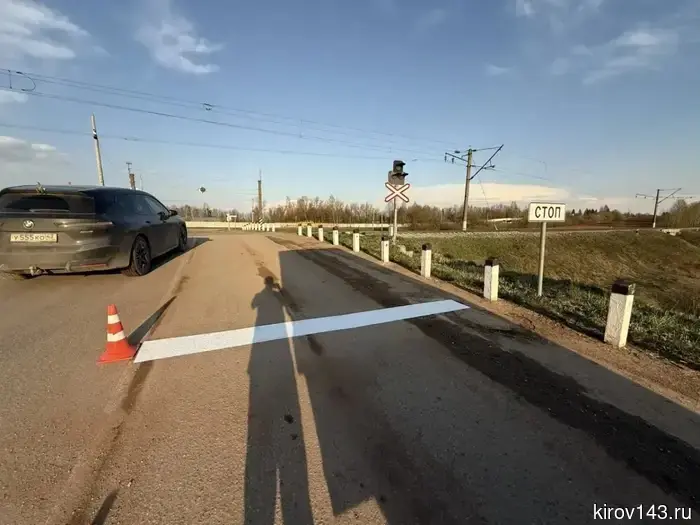 The administration was forced to secure the railway crossing in Kirov.
The bailiffs achieved the elimination of violations at the railway crossing, where accidents regularly occurred due to issues with traffic organization.
The administration was forced to secure the railway crossing in Kirov.
The bailiffs achieved the elimination of violations at the railway crossing, where accidents regularly occurred due to issues with traffic organization.
 The Legislative Assembly supported mandatory escrow accounts for all mortgage holders.
The deputies approved the governor's initiative.
The Legislative Assembly supported mandatory escrow accounts for all mortgage holders.
The deputies approved the governor's initiative.
 In transport universities in Russia, students will be taught to operate drones.
Starting from September 1, a unified course on unmanned transport systems will be introduced in specialized universities across the country.
In transport universities in Russia, students will be taught to operate drones.
Starting from September 1, a unified course on unmanned transport systems will be introduced in specialized universities across the country.
Fraud: how not to become a victim of the global epidemic
Every day in the news feed, there are dozens of reports about yet another Russian who has transferred hundreds of thousands and even millions of rubles to scammers. The number of victims is not decreasing. Along with it, the appetites of the criminals are growing. But the most frightening thing is that almost every victim was aware of the existence of telephone scammers. They saw warnings from the police and banks, read the news, heard about "safe accounts" and "codes from SMS." They knew — but still transferred the money.