
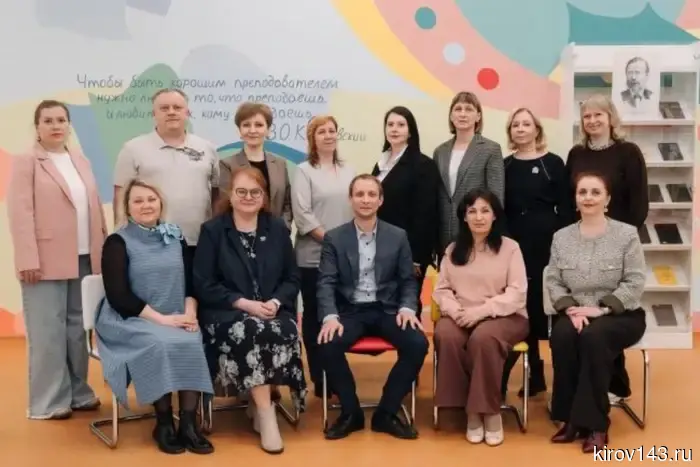
VyatSU Teams: Heads of Educational Profile Programs
For the third year, a new model of pedagogical education is being implemented at Vyatka State University. How many heated discussions, brainstorming sessions, and strategic meetings involving absolutely all representatives of the professional community in the region preceded the launch of this initiative! As a result, the optimal variant was crystallized, taking into account the maximum aspects and potential challenges, the main distinction and advantage of which students cite as the opportunity for free, sometimes unconventional, combination of two chosen educational profiles. This is detailed in the relevant section of the VyatGU website.
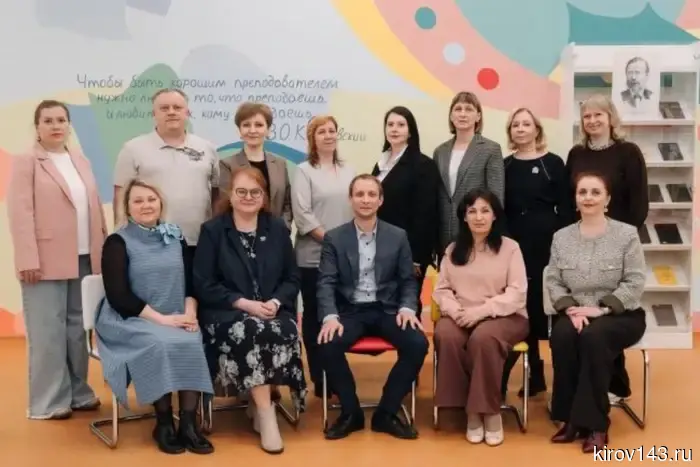
We will turn to those people who help make the right choice, guiding students from the start of their studies to graduation. These are the heads of educational programs, each of whom is a top-level professional, well-versed in their subject and capable of finding an approach to their mentees. It was precisely these individuals that the leadership of the Pedagogical Institute of VyatGU initially focused on, inviting experienced colleagues from various faculties to collaborate. They have formed a cohesive team of like-minded individuals. Currently, 20 heads of educational programs are working within the new model. Each of them is responsible for their educational trajectory; they supervise students who have chosen it. At the same time, the heads of educational programs closely interact with each other both in the current educational process and at meetings of the Academic Council of heads of educational programs, chaired by the director of the Pedagogical Institute, Galina Ivanovna Simonova.
Today we have three interviewees, whose conversation will help us better understand not only the specifics of their work but, most importantly, the prospects that open up for students who have chosen pedagogy.
Marina Ivanovna Tolmacheva, a senior lecturer in the Department of Physics at VyatGU, heads the educational trajectory "Physics Teacher." It is no secret that today's school graduates are reluctant to become physics teachers. Why? Because the subject is indeed complex, and school knowledge is not always mastered at the required level. This happens for various reasons: due to the lack of a strong teacher (the current school is experiencing a particular shortage of physics teachers); the modern experimental base that allows the subject teacher to demonstrate all the facets of this fascinating discipline to students; difficulties in catching up on missed material due to objective reasons or one's own frivolity. Thus, students emerge with serious gaps in the subject – it seems obvious to them that they can give up on physics.
However, it turns out that this is far from always the case. The situation can change with a meeting with a good teacher who can engage and motivate their mentees, providing them with solid knowledge.
"In the first year, we have a course called 'Physics Around Us,' most of which is dedicated to physical experiments. For each class, I select demonstration equipment for one of the sections of physics – and throughout the class, we have something spinning, glowing, or flying. Then, at the end of the class, we answer many 'whys,' transferring everything we saw to real-life situations," Marina Ivanovna shared.
Step by step, first-year students become interested and involved – their eyes literally open: wow, physics is so exciting! Yes, a talented teacher intentionally shows how interesting and engaging it is. And, at first glance, it seems simple. However, the conversation is honest: physics is not just the "magic" of experiments; it is serious knowledge, complex subjects, the mastery of which requires effort and work.
"I tell the students that they will have a laboratory practicum, and there will be lectures on difficult topics. Moreover, we need to be able to solve problems: after all, teachers in school need to prepare children for the Unified State Exam and Olympiads.
It's not all that simple, but if you like it, we will teach you," summarizes Marina Ivanovna.
The main reward for her is to see that students truly "immerse" themselves in physics to the extent that they want to dedicate their lives to it and subsequently pass on the knowledge they have gained to others. And in some school, accordingly, there will appear the much-needed and desired specialist.
The issue of the quality of teacher training is also at the forefront for Olga Nikolaevna Perestoronina, the head of the "Biology Teacher" profile, an associate professor in the Department of Biology and Methods of Teaching Biology at VyatGU. She notes:
"We have a complex science. Biology encompasses both botany and zoology; it includes human morphology and physiology, as well as various general biological sections, from the theory of evolution to ecology. There is a lot to know, and students often fear this volume."
We simply need to teach. Specifically, to teach – thoughtfully, with understanding; not just to search for information. This message from the teacher is hard not to share: after all, true knowledge does not come without effort; achieving results is always a kind of overcoming, reaching the next peak: whether it is preparing for a lesson or an exam, writing a term paper or a thesis. Only in this way does a solid, foundational base of professionalism emerge, allowing one to subsequently tackle tasks of any complexity, to build new competencies – moreover, to instill them in others.
Olga Nikolaevna shared her experience of interdisciplinary interaction, a vivid example of which was the event "Flowers and Memory," organized last year for the 80th anniversary of Victory in the Great Patriotic War in collaboration with colleagues from the "Teacher of Basics of Safety and Defense of the Motherland" and "Literature Teacher" profiles:
"It was a successful joint project, where students from different profiles shared knowledge and tried themselves in somewhat unfamiliar roles. Biology students, for example, were able not only to talk about the plants from the areas where combat actions took place. Together with literature students, they read poems on military themes, the central images of which were the flowers and trees familiar to the Soviet soldier. In the poetic lines, the plants were given special meaning, becoming symbols of love for the Motherland. A lot of interesting information about the use of plants as makeshift means was prepared by future teachers of the basics of safety and defense of the Motherland."
Many similar events have been organized by the team of heads of educational programs, and many more are yet to come! In particular, an interdisciplinary seminar dedicated to the connections between physics and the Russian language is approaching. It sounds very intriguing!
All school subjects are equally important – life itself constantly confirms this thesis. By choosing any educational profile, an applicant can be sure: as a teacher, they will be in demand in full measure. This also applies to a trajectory such as "Technology Teacher."
"In the past, there was a joke that the best wives come from girls who chose the specialty 'Labor Teacher': after all, they sew, cook, and can fix an iron. Now the subject area 'Technological Education' has significantly expanded: in addition to traditional skills, future teachers are mastering many new competencies. Students study robotics, 3D modeling – all of this they will have to apply in lessons, passing it on to children," said Lena Valeryevna Morilova, head of the Department of Technology and Methods of Teaching Technology at VyatGU, and head of the educational program "Technology Teacher."
Thus, the spectrum of professional competencies for teachers of this discipline has multiplied. At the same time, the interviewee noted, there has been a pronounced trend towards manual labor in our days:
"This is the study of past experiences, a return to traditions – in the best sense of these concepts. Today, in the age of technology, manual labor has become in demand. For example, our students are currently working on a project dedicated to wood carving on their initiative. I have no doubt that instilling a love and habit for manual labor in modern children is essential."
It is noteworthy that in implementing this approach, teachers refer to the works of their senior colleague Nikolai Vasilyevich Kotryakhov, a professor in the Department of Pedagogy at VyatGU, a recognized authority in the scientific community.
Some may think: each head of an educational program is only interested in their discipline, in enrolling students exclusively in their profile. This is not the case. The professionalism of each individual teacher and the team as a whole is determined by their focus on the best final result – to prepare intelligent, knowledgeable teachers capable not only of conveying their subject to schoolchildren but also of being a worthy example of enduring human qualities: integrity, responsibility, fairness, and responsiveness.
These are the qualities demonstrated by the heads of educational programs in their communication with students and among themselves – is this not the most impressive example?
In concluding the conversation, the teachers note:
"We solve all issues in the team very kindly. When it comes to students' choices, there are sometimes light disputes, but the question is always resolved in favor of the students.
Students' interests always take precedence over our personal interests." Recently, the heads of educational programs participated in a photo session organized by the press service of VyatGU. Due to their busy schedules, not all 20 members of the Academic Council were able to attend at the designated time. However, we treat all of them with great respect and dedicate this material to the entire team of heads of educational programs in pedagogical education at VyatGU.
Другие Новости Кирова (НЗК)
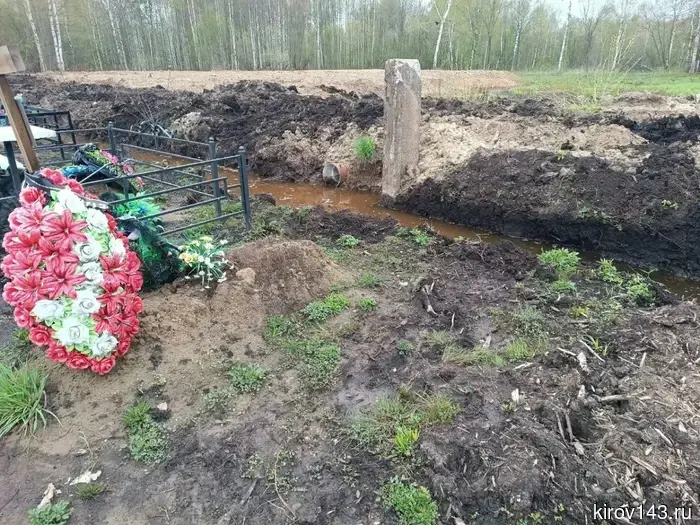 Simakov apologized for the flooded cemetery.
The head of the administration of Kirov commented on the situation.
Simakov apologized for the flooded cemetery.
The head of the administration of Kirov commented on the situation.
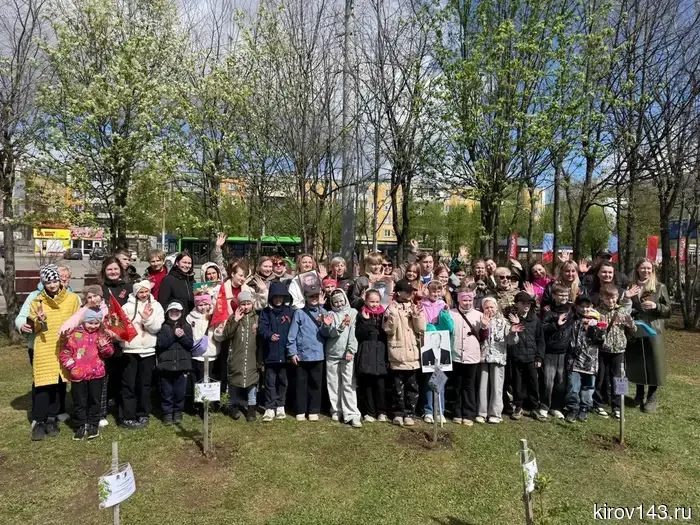 Kirov schoolchildren planted lilacs at the monument to Marshal Konev on Victory Day.
On the 81st anniversary of the Great Victory, the students of the Children's Creativity House "Inspiration," along with their parents and teachers, joined the all-Russian campaign "Gardens of Memory." They planted lilac bushes at the monument to Marshal of the Soviet Union Ivan Konev.
Kirov schoolchildren planted lilacs at the monument to Marshal Konev on Victory Day.
On the 81st anniversary of the Great Victory, the students of the Children's Creativity House "Inspiration," along with their parents and teachers, joined the all-Russian campaign "Gardens of Memory." They planted lilac bushes at the monument to Marshal of the Soviet Union Ivan Konev.
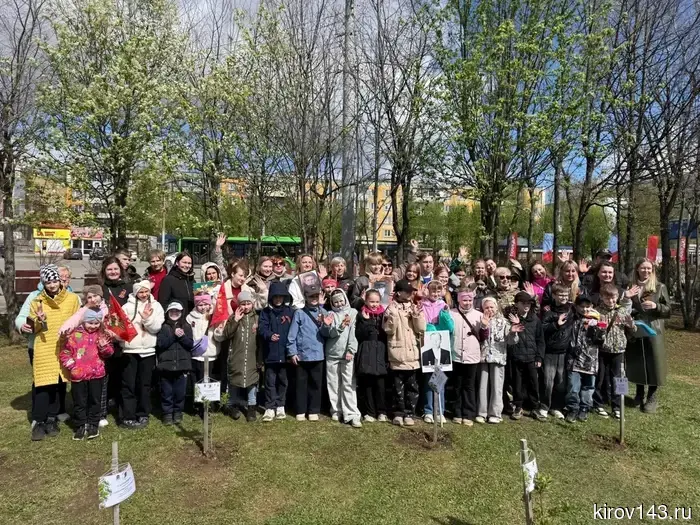 Kirov schoolchildren planted lilacs at the monument to Marshal Konev on Victory Day.
On the 81st anniversary of the Great Victory, the students of the Children's Creativity House "Inspiration," along with their parents and teachers, joined the all-Russian campaign "Gardens of Memory." They planted lilac bushes at the monument to Marshal of the Soviet Union Ivan Konev.
Kirov schoolchildren planted lilacs at the monument to Marshal Konev on Victory Day.
On the 81st anniversary of the Great Victory, the students of the Children's Creativity House "Inspiration," along with their parents and teachers, joined the all-Russian campaign "Gardens of Memory." They planted lilac bushes at the monument to Marshal of the Soviet Union Ivan Konev.
 VyatSU Teams: Heads of Educational Profile Programs
The new material of our media project is, as usual, addressed to a wide audience of readers. Moreover, it is related to the pressing issue of the shortage of subject teachers, one of the most acute problems in modern schools. VyatSU is preparing educators - a new enrollment of students is ahead; therefore, we especially invite future applicants and their parents to read this text.
VyatSU Teams: Heads of Educational Profile Programs
The new material of our media project is, as usual, addressed to a wide audience of readers. Moreover, it is related to the pressing issue of the shortage of subject teachers, one of the most acute problems in modern schools. VyatSU is preparing educators - a new enrollment of students is ahead; therefore, we especially invite future applicants and their parents to read this text.
 A resident of Nema was sent to a colony for unpaid alimony.
In the Nemskiy District, a verdict was delivered to a 43-year-old local resident who was found guilty of failing to pay alimony for the support of three minor children.
A resident of Nema was sent to a colony for unpaid alimony.
In the Nemskiy District, a verdict was delivered to a 43-year-old local resident who was found guilty of failing to pay alimony for the support of three minor children.
VyatSU Teams: Heads of Educational Profile Programs
The new material of our media project is, as usual, addressed to a wide audience of readers. Moreover, it is related to the pressing issue of the shortage of subject teachers, one of the most acute problems in modern schools. VyatSU is preparing educators - a new enrollment of students is ahead; therefore, we especially invite future applicants and their parents to read this text.