
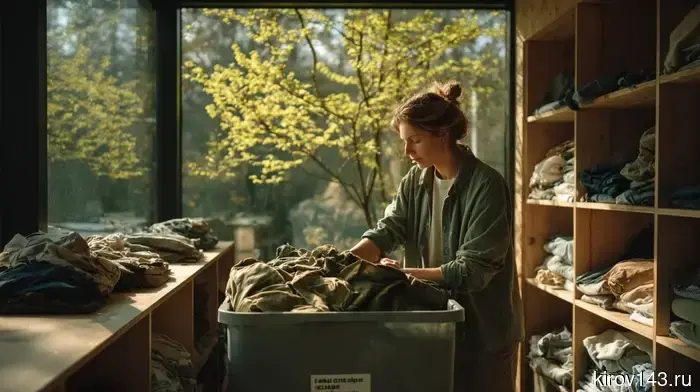
Jeans, children's clothing, and t-shirts: what Russians most often recycle
Collection points and specialized containers for clothing are gradually becoming a familiar element of the urban environment. This allows us to assess which items people donate most often and what happens to them next.
Jeans and trousers are leaders among textile waste
The largest share consists of jeans and trousers — they account for 30–35% of the total volume of collected textiles, according to statistics from the MediaCorSvet portal.
Such wardrobe items are practically owned by everyone, and their material (cotton with synthetic additives) is well-suited for recycling, although their appearance deteriorates over time.
Children's clothing — a quarter of the total collection
In second place is children's clothing, which accounts for 25%.
Children quickly outgrow their clothes, so they often remain in almost perfect condition and are readily sent for recycling or reuse. There are entire groups on popular services and social networks, and finding them is not difficult.
T-shirts, blouses, and tops: one-fifth of the volume
About 20% of the collected textiles are thin knitted items made of cotton with synthetic fibers.
They are usually donated due to color loss, the appearance of pills, or difficult-to-remove stains.
Outerwear: seasonal demand
Outerwear accounts for 10–15% of the total volume. It is most often donated in spring and autumn.
Even if the hardware (zippers, buttons) is worn out, the fabric — polyester, drape, or raincoat material — often remains in good condition and suitable for recycling.
What else is donated and where it goes
Other textile waste includes bags, belts, bed linens, and curtains. Some of the collected items are sent to charitable organizations.
Men's clothing is especially in demand for helping the homeless, teenage clothing for children in orphanages, as well as household textiles and bed linens for shelters and crisis centers.
How things are in the Kirov region
In the Kirov region, the textile collection system is in a phase of active development. Starting in 2025, a dual waste sorting system will be implemented in the region: one container will be designated for all recyclable materials (including textiles), and another for other waste.
For this purpose, 721 locations have been selected in the regional center for the installation of additional containers. The city requires about 2,400 bins for separate collection in total. Additionally, in 2025, municipalities in the region received about 3,500 new waste containers.
As of the end of 2025, there are more than 200 clothing collection points operating in the Kirov region. In Kirov, clothing can be donated, for example, at the following addresses:
Klubnaya St., 19 — Kirov City Comprehensive Social Service Center (Novovyatsky District). Schedule: Mon–Fri 08:00–17:00.
Gorky St., 57 — clothing collection point. Schedule: Mon–Fri 10:00–19:00, Sat 10:00–17:00, Sun 10:00–16:00.
Karl Marx St., 20 — clothing collection point.
Lenin St., 72 - Ecoexchange Charitable Warehouse.
These collection points are sourced from open sources. The collected items are distributed in several directions: some go to free exchanges, some are given to those in need, and items unsuitable for wearing are used as rags — for example, for animal shelters.
Commercial organizations for textile recycling also operate in the region. LLC "Ekovtor" (Kirov, Luganskaya St., 47a) is engaged in the collection and recycling of textile waste.
Why this is important
Experts emphasize: proper handling of clothing is not only a contribution to ecology but also a resource for charity. Jeans and t-shirts can be sent for recycling, while coats or trousers in good condition can gain a new life through social programs. Using special containers and services for textiles instead of throwing them into mixed waste helps reduce the burden on landfills and gives items a second chance.
Другие Новости Кирова (НЗК)
 Shishkin or Kanash: a new member of the Public Chamber will be elected in the Kirov region
The deputies reviewed the two proposed candidates.
Shishkin or Kanash: a new member of the Public Chamber will be elected in the Kirov region
The deputies reviewed the two proposed candidates.
 New electric locomotives have been brought to Kirov.
Old Czech electric locomotives are being replaced.
New electric locomotives have been brought to Kirov.
Old Czech electric locomotives are being replaced.
 GDMS will re-equip the equipment by summer.
At Gordormoststroy, preparations for the fleet of equipment for the summer season of maintaining Kirov streets have begun.
GDMS will re-equip the equipment by summer.
At Gordormoststroy, preparations for the fleet of equipment for the summer season of maintaining Kirov streets have begun.
 Barshina has left the Public Chamber.
The reason was a heavy workload.
Barshina has left the Public Chamber.
The reason was a heavy workload.
 Business horoscope: Leos will do twice as much, while Capricorns will be too lazy to work.
Astrologers have reported how things will go for all zodiac signs on the upcoming working Tuesday.
Business horoscope: Leos will do twice as much, while Capricorns will be too lazy to work.
Astrologers have reported how things will go for all zodiac signs on the upcoming working Tuesday.
 The "stuck" plane in St. Petersburg arrived in Kirov this evening.
According to the online board of Kirov airport Pobedilovo, the flight from St. Petersburg landed in Kirov at 5:35 PM.
The "stuck" plane in St. Petersburg arrived in Kirov this evening.
According to the online board of Kirov airport Pobedilovo, the flight from St. Petersburg landed in Kirov at 5:35 PM.
Jeans, children's clothing, and t-shirts: what Russians most often recycle
In cities where textile containers operate, unofficial statistics have emerged regarding which items are most frequently deposited in the bins. Jeans, children's clothing, and knitwear lead the list. Moreover, some of the collected items do not go for recycling but are sent to charitable centers, where men's and teenage clothing is especially in demand.