

Dog handlers explained how to protect dogs from ticks.
The President of the Russian Cynological Federation, Vladimir Golubev, warns dog owners: walking in March and early April is far from safe.
"Spring parasites are often even more dangerous, as they are more active after hibernation and immediately attack their prey," the expert explained.
Ticks carry several deadly diseases: pyroplasmosis (babesiosis), borreliosis (Lyme disease), and ehrlichiosis. Alarming symptoms after a bite include dark urine, lethargy, loss of appetite, and fever. Without treatment, a dog can die within a few days. Not all parasites are carriers, but the risk is unjustified.
How to protect your pet
There is no 100% protection against ticks. The more methods you use, the higher the chance of keeping your dog safe.
The most common method is tablets. They work through the bloodstream and are usually given once every 1–3 months. The tick dies immediately after biting, without having time to infect the animal. The downside: it is not suitable if the dog refuses to swallow tablets or has a sensitive gastrointestinal tract.
The second option is drops on the withers. The product repels or kills the tick before it bites. Disadvantages: the dog cannot be washed two days before and after application, and in the first day after treatment, it is recommended to minimize contact with it. For those who love to swim, this method is less suitable.
The third option is special collars. They should be used as a supplement, not as the main method. The collar should be put on in advance, 1–2 weeks before going into the woods or nature. If it is loose, its effectiveness decreases.
For emergency protection before a walk, repellents can be used. They should be applied strictly in nature, choosing products only from pet stores—human ones can be toxic to dogs.
It is also important to remember about vaccination. It does not prevent bites but alleviates the course of the disease and reduces the risk of death.
Additional safety measures
Ticks hide in bushes and tall grass, so it is advisable to avoid such places whenever possible. After each walk, a thorough inspection is necessary, especially if the dog has long fur and a thick undercoat. Brushing your pet with a de-shedding tool after being outside is also helpful.
If a tick is found
It is best to remove the parasite with a thin tweezers or a special tick remover, which should be purchased in advance. Grasp as close to the skin as possible and pull out with twisting motions. Do not apply oil to the tick: it will die but will have time to infect the blood.
After removal, disinfect the wound with chlorhexidine. It is important to monitor the bite site and the overall condition of the pet. At the first signs of suspicious symptoms—especially if the color of the urine changes—immediate consultation with a veterinarian is necessary.
Другие Новости Кирова (НЗК)
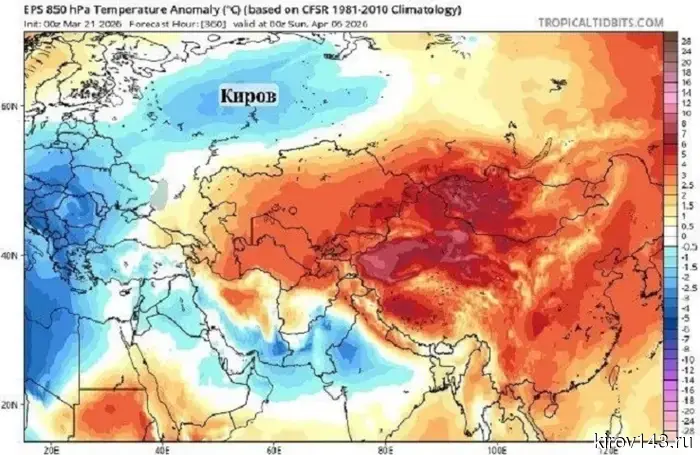 April may greet Kirov residents with cold and precipitation.
The current heat wave in the Kirov region, apparently, will not last long. According to the Telegram channel "Amateur Meteorology in Kirov," the region may find itself in a cold zone again in early April.
April may greet Kirov residents with cold and precipitation.
The current heat wave in the Kirov region, apparently, will not last long. According to the Telegram channel "Amateur Meteorology in Kirov," the region may find itself in a cold zone again in early April.
 "Dangerous Ice": Kirov Residents Warned About Threats on Water Bodies
Warm weather has settled in Kirov. Due to the daytime positive temperatures, the ice on the water bodies is quickly losing strength.
"Dangerous Ice": Kirov Residents Warned About Threats on Water Bodies
Warm weather has settled in Kirov. Due to the daytime positive temperatures, the ice on the water bodies is quickly losing strength.
 "Battery is running low": who is at risk of a heart attack due to sudden weather changes and why weather dependence is not a myth
Many attribute their poor well-being to "silly weather," and sometimes this is indeed justified. Doctors remind us that sharp fluctuations in temperature, atmospheric pressure, and magnetic storms are not just discomforts, but a serious blow to the body. There are groups of people for whom such whims of nature can be truly dangerous.
"Battery is running low": who is at risk of a heart attack due to sudden weather changes and why weather dependence is not a myth
Many attribute their poor well-being to "silly weather," and sometimes this is indeed justified. Doctors remind us that sharp fluctuations in temperature, atmospheric pressure, and magnetic storms are not just discomforts, but a serious blow to the body. There are groups of people for whom such whims of nature can be truly dangerous.
 Two years of tragedy at "Krokus"
Exactly two years ago, on March 22, 2024, the evening before the concert of the band "Piknik" at the Moscow region's "Crocus City Hall" marked the beginning of one of the most terrible tragedies in modern Russian history.
Two years of tragedy at "Krokus"
Exactly two years ago, on March 22, 2024, the evening before the concert of the band "Piknik" at the Moscow region's "Crocus City Hall" marked the beginning of one of the most terrible tragedies in modern Russian history.
 In Kirov, two fires occurred within a day.
On March 21, fire and rescue units of the Kirov region extinguished two man-made fires, reported the regional department of the Ministry of Emergency Situations.
In Kirov, two fires occurred within a day.
On March 21, fire and rescue units of the Kirov region extinguished two man-made fires, reported the regional department of the Ministry of Emergency Situations.
 A Kirov resident returned with two medals from the Wushu Spartakiad.
Darya Semakina competed against 160 athletes from 33 regions of Russia, as well as from the People's Republic of China.
A Kirov resident returned with two medals from the Wushu Spartakiad.
Darya Semakina competed against 160 athletes from 33 regions of Russia, as well as from the People's Republic of China.
Dog handlers explained how to protect dogs from ticks.
As soon as the snow melts and the ground warms up to 5 degrees, ticks awaken. Their peak activity in the central region occurs in April-May, but the parasites are already starting to hunt now.