

Results of the first Federal Auto Summit: key trends of the automotive market through 2028
As part of the event, experts discussed changes in buyer behavior, the sustained trend toward digitalization of the industry, as well as government policy in regulating the car market, including new legislative initiatives and support measures for dealers.
Key statistics and consumer demand trends
Speakers presented up-to-date data showing market dynamics:
Demand for new cars in October 2025 rose by 12.3% year on year. The most in-demand (31.5%) were cars priced between 2 and 3 million rubles. In the secondary market, demand grew by 26.6% from June to October, with 87% of user interest concentrated on budget cars up to 2 million rubles. Average prices are declining: for new cars — to 3,410,000 rubles (-0.9%), for used cars — to 1,440,000 rubles (-7.4%).
Buyers are actively moving into the digital space: 85% of consumers begin their search online, and the share of communication with sellers via chats grew over the year from 58% to 72%.
The share of new-car buyers increased by 10 percentage points to 37%. The share of those who previously bought used cars but have now switched to new cars rose by 4 percentage points.
Digitalization as the basis of new business strategies
In response to changing buyer behavior, market players are adapting their approaches.
Experts highlighted key development directions.
Platformization — a comprehensive approach to unifying all services into a single ecosystem. At its core are solutions that help dealers manage key business processes: from sourcing vehicles and restocking inventory to sales and analytics.
Development of services for secure transactions — the implementation of tools that allow users to complete all selection stages online, and enable dealers to increase efficiency in sales and procurement. For example, services that allow finding a buyer in just 2 hours and selling a car in 2 days are becoming an additional channel for replenishing dealer inventories.
The view of manufacturers and dealers
Natalya Gremitskikh, project director of the marketing directorate at JSC AVTOVAZ, spoke about the company's plans to implement a dealer center management system and hosting, including automated content management and the development of a loyalty system. She noted that working with large online platforms is part of the company's strategy.
Oleg Kuznetsov, Deputy General Director for Digital Transformation of the Autodom Group and Avtospeccenter, shared his experience in creating a customer experience by making services fully available online and making decisions based on data, volga.news reports.
Forecasts through 2028
The summit's central event was the panel discussion “The Russian Car Market through 2028.” Its participants identified key trends.
Younger buyers pay more attention to a car’s ease of use rather than its technical specifications.
By 2028, around 20% of all car transactions may be conducted online. The key to success is synergy between online and offline, and flexibility in customer interaction will become critically important.
Trust is a new asset: sellers with transparent and convenient service will gain a competitive advantage.
International experience was also presented: experts from Saudi Arabia shared a case study of transforming the local car market, where today the buyer expects the same seamless experience when purchasing a car as when ordering from global e‑commerce giants.
Другие Новости Кирова (НЗК)
 Repairs to the water supply system in Sovetsk are expected to be completed in 2026.
Work is over 80% complete.
Repairs to the water supply system in Sovetsk are expected to be completed in 2026.
Work is over 80% complete.
 Nearly 3,400 residents of Kirov Oblast assessed their IT competencies.
Over five months of operation, the national IT skills verification system launched by hh.ru and the Ministry of Digital Development saw more than 3,000 residents of Kirov Oblast and 367,000 Russians in total assess their skills.
Nearly 3,400 residents of Kirov Oblast assessed their IT competencies.
Over five months of operation, the national IT skills verification system launched by hh.ru and the Ministry of Digital Development saw more than 3,000 residents of Kirov Oblast and 367,000 Russians in total assess their skills.
 "'Cash collection' over the phone nearly deprived an 86-year-old Kirov resident of all his savings."
In Kirov, an 86-year-old pensioner almost lost all his savings to phone scammers who were using the now-familiar "data leak" and "cash collection" scheme.
The echo of the "nude party" in Sosnovka "receded" from the authorities.
For eight months now the Vyatskiye Polyany law-enforcement agencies have apparently been pretending not to know anything about the "naked party" that took place in Sosnovka and its participants.
"'Cash collection' over the phone nearly deprived an 86-year-old Kirov resident of all his savings."
In Kirov, an 86-year-old pensioner almost lost all his savings to phone scammers who were using the now-familiar "data leak" and "cash collection" scheme.
The echo of the "nude party" in Sosnovka "receded" from the authorities.
For eight months now the Vyatskiye Polyany law-enforcement agencies have apparently been pretending not to know anything about the "naked party" that took place in Sosnovka and its participants.
 In Kirov, the evacuation plan in the park at Teatralka was covered up.
An evacuation plan in the park on Theatre Square—which had earlier been found to contain inaccuracies in the street names listed as evacuation routes for residents of Kirov—was covered with a black plastic bag and taped over.
In Kirov, the evacuation plan in the park at Teatralka was covered up.
An evacuation plan in the park on Theatre Square—which had earlier been found to contain inaccuracies in the street names listed as evacuation routes for residents of Kirov—was covered with a black plastic bag and taped over.
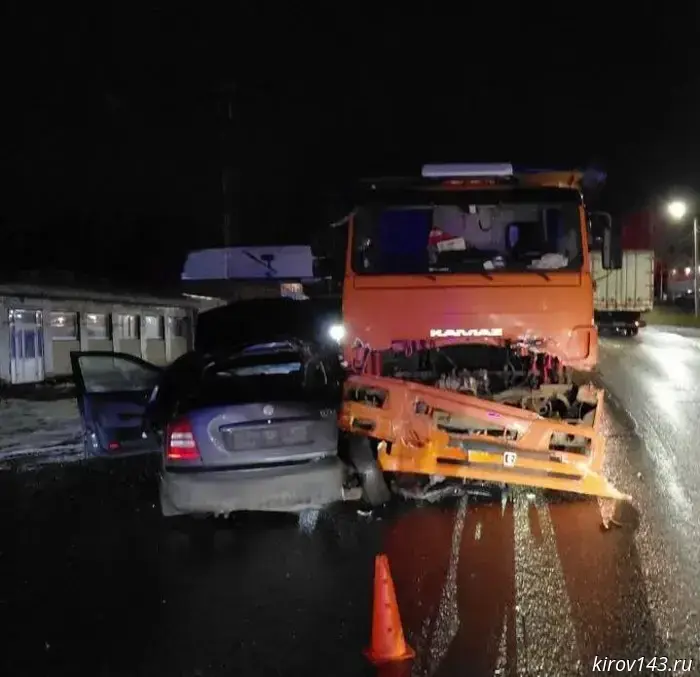 A multi-vehicle crash occurred in Kirovo-Chepetsk.
Four cars collided near a traffic police checkpoint.
A multi-vehicle crash occurred in Kirovo-Chepetsk.
Four cars collided near a traffic police checkpoint.
Results of the first Federal Auto Summit: key trends of the automotive market through 2028
In Moscow, in the final days of November, the first federal Auto Summit took place, bringing together more than a thousand participants — manufacturers, dealers, exporters, fintech experts and regulators, including representatives of the Central Bank of the Russian Federation. At the center of the discussion were the main drivers of the automotive market's transformation.