

Alcohol consumption in Russia is decreasing.
Alcohol consumption in Russia by the end of 2025 decreased to 8.06 liters of pure alcohol per capita. According to estimates for June 2026, the figure will be 7.77 liters, which will be the lowest value since the late 1990s, reported RBK, head of the prevention department of the Central Research Institute of Organization and Informatics of Health Care of Russia Viktor Zykov.
As explained by the president of the "Alcopro" guild, Andrey Moskovsky, the decrease does not mean a mass refusal of alcohol. People are buying alcohol less frequently, switching to lower-strength drinks, and moving between categories. For example, if instead of vodka they buy a sweet tincture with a strength of 20-25%, the amount of ethanol in the statistics decreases, but the person does not become a teetotaler.
In the first half of 2026, consumption of almost all categories of alcohol decreased, except for liqueur-vodka products and sparkling wine. According to Rosalkogoltabakcontrol, vodka sales increased by 0.25%, liqueur-vodka products by 11.54%, and strong alcohol overall by 1.51%. Cognac lost 2.41%, and other alcoholic beverages lost 1.19%.
However, experts point out that the growth in statistics is explained by the inclusion of four new regions. In comparable territory, the strong market decreased by 0.9% in the first half of the year, vodka lost 2.4%, and cognac lost 6%.
Sales of still wine decreased by 2.7%, while sparkling wines increased by 3.9%. Beer production in the first half of the year decreased by 2.4% compared to the same period in 2025. The Association of Beer Producers notes that since mid-2025, the market has seen a shift from a positive to a negative trend.
Among the reasons for the decrease in consumption, experts cite a set of anti-alcohol measures by the state: restrictions on the place and time of sale, increased excise taxes, and the fight against illegal trade. Economic factors also play a role—alcohol has become more expensive due to rising prices and excise burdens. This is especially noticeable in the still wine segment, where prices have risen from 500 to 1,000 rubles and higher over two years.
The increase in interest in liqueur-vodka products is linked by experts to the popularity of homemade cocktails. Consumers who previously preferred wine are now choosing these drinks due to rising wine prices and an increase in the minimum retail price of vodka by 17% at the beginning of 2026.
Additionally, the reduction in consumption is explained by demographic factors and a trend towards a healthy lifestyle. The younger generation is smaller in number, drinks differently, and does not automatically become a copy of the older generation. Alcohol has ceased to be an obligatory part of socializing and coming of age.
Market participants expect further reductions in consumption. According to forecasts, in 2026, sales of strong drinks in comparable territory will decrease by 1.5-2%. The downward trend is likely to continue into 2027, although seasonal adjustments are possible.
Recall that we previously reported that the Kirov region ranked among the top three in beer consumption in Russia. By the end of 2025, the region took third place, yielding only to the Murmansk and Sverdlovsk regions. The average resident of the Kirov region over 18 years old drank 94.4 liters of beer in a year—almost one and a half times higher than the national average (61.5 liters). The top five also included the Komi Republic (91.7 liters) and Karelia (89.1 liters). Meanwhile, overall beer consumption in Russia decreased by 15.5% over the year—experts attribute this to rising excise taxes and a reduction in the number of sales points.
Другие Новости Кирова (НЗК)
 Banks will no longer be able to hide the terms of deposits and loans.
In Russia, the rules for disclosing information about banking services will be changed. Financial organizations will be required to provide detailed information to clients about all the terms of their products.
Banks will no longer be able to hide the terms of deposits and loans.
In Russia, the rules for disclosing information about banking services will be changed. Financial organizations will be required to provide detailed information to clients about all the terms of their products.
 The public services have opened the selection of voting formats for the September elections.
The State Services portal has started accepting applications for the method of participation in the elections, which will take place from September 18 to 20. Applications can be submitted until September 14.
The public services have opened the selection of voting formats for the September elections.
The State Services portal has started accepting applications for the method of participation in the elections, which will take place from September 18 to 20. Applications can be submitted until September 14.
 The associate professor of VyatGU taught young parliamentarians of the region the techniques of public speaking.
At the Kirov State Universal Regional Scientific Library named after A.I. Herzen, a conference titled "Youth Parliamentarism: Challenges and Opportunities" was held.
The associate professor of VyatGU taught young parliamentarians of the region the techniques of public speaking.
At the Kirov State Universal Regional Scientific Library named after A.I. Herzen, a conference titled "Youth Parliamentarism: Challenges and Opportunities" was held.
 Scientists have discovered traces of an unknown extinct species in human DNA.
An international group of researchers has stated that traces of an unknown population of ancient hominins have been preserved in the genomes of modern humans, a population that was previously unknown. The scientists reached this conclusion using a new method of DNA analysis.
Scientists have discovered traces of an unknown extinct species in human DNA.
An international group of researchers has stated that traces of an unknown population of ancient hominins have been preserved in the genomes of modern humans, a population that was previously unknown. The scientists reached this conclusion using a new method of DNA analysis.
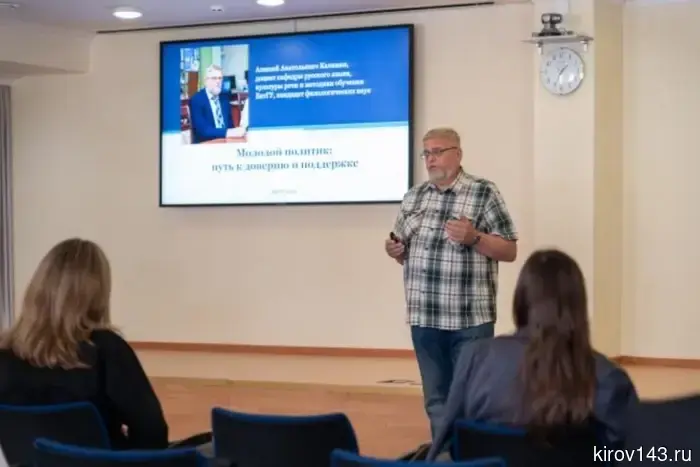 Associate Professor of VyatGU trained young parliamentarians of the region in the techniques of public speaking.
At the Kirov State Universal Regional Scientific Library named after A.I. Herzen, a conference titled "Youth Parliamentarism: Challenges and Opportunities" was held.
Associate Professor of VyatGU trained young parliamentarians of the region in the techniques of public speaking.
At the Kirov State Universal Regional Scientific Library named after A.I. Herzen, a conference titled "Youth Parliamentarism: Challenges and Opportunities" was held.
 Куда можно зайти кировчанам в период с 3 по 7 августа?
Герценка: 3 августа в 18:00 — лекция «Как молодежь развлекалась в Вятке 100 лет назад». 4 августа в 17:00 — музыкальный концерт. 5 августа с 11:00 до 16:00 — мастер-класс «Шерстяная сказка», создание картин из шерсти. В 14:00 — обзорная экскурсия по библиотеке. 6 августа в 17:30 — лекция «Жизненная энергия:
Куда можно зайти кировчанам в период с 3 по 7 августа?
Герценка: 3 августа в 18:00 — лекция «Как молодежь развлекалась в Вятке 100 лет назад». 4 августа в 17:00 — музыкальный концерт. 5 августа с 11:00 до 16:00 — мастер-класс «Шерстяная сказка», создание картин из шерсти. В 14:00 — обзорная экскурсия по библиотеке. 6 августа в 17:30 — лекция «Жизненная энергия:
Alcohol consumption in Russia is decreasing.
According to estimates from the Ministry of Health, alcohol consumption per capita may reach its lowest point since the late 1990s by 2026. However, the reduction in volumes is not due to a rejection of alcohol, but rather a shift to weaker drinks and changes in consumer habits.