
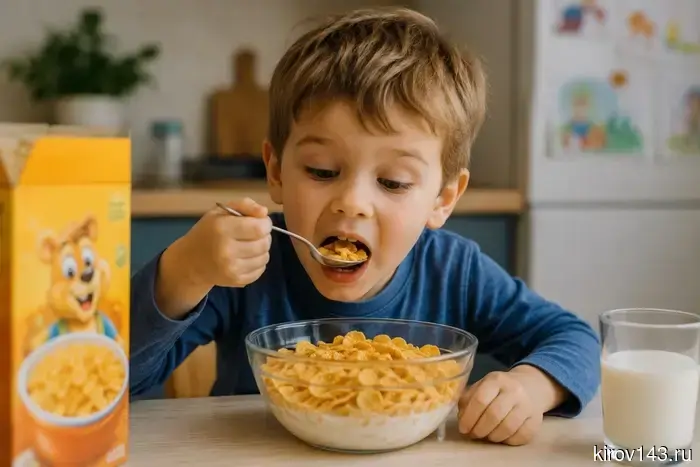
Dry breakfasts turned out to be dangerous for children's immunity.
The foundation of health is the microbiome
The gut microbiome plays a key role in shaping children's health. A child's diet should include a sufficient amount of complex carbohydrates, proteins, and a limited amount of fats. However, not all cereals are equally beneficial. The difference between whole grains and grains used for instant cereals is enormous. The latter are processed grains, stripped of many beneficial layers.
As explained by Olga Vladimirovna Tarasova, a candidate of medical sciences and associate professor of the Department of Hospital Pediatrics No. 2 at the Pirogov University Institute of Motherhood and Childhood, cereals made from whole grains contain probiotic complexes that are beneficial for the gut. In dry breakfasts—flakes, muesli, instant cereals—these complexes are absent.
What happens in the gut after sweet cereals
Consuming processed cereals leads to a reduction in beneficial microflora—bifidobacteria—and an increase in conditionally pathogenic flora. This causes disruptions in the gastrointestinal tract and can lead to gastritis even in infants and schoolchildren.
Moreover, dry breakfasts contain a lot of sugar. This is a direct path to metabolic disorders, obesity, and an increased risk of diabetes in the future.
The effect that instant cereals lack
Large studies compared two groups of products. The first included cereals made from whole and crushed grains with low sugar content (about 14%).
The second included instant cereals made from processed, boiled grains with high starch content.
The beneficial effect for gut microflora provided by full-fledged cereals is completely absent in their instant counterparts. Moreover, they worsen the composition of microflora.
A blow to immunity: why children start getting sick more often
The majority of the human immune system is located in the abdominal cavity. A good microflora "feeds" immune cells—lymphocytes. These are carried throughout the body by the bloodstream, reaching the mucous membranes of the lungs and providing protection against viruses. When the balance of microflora is disrupted, immune protection decreases.
According to Olga Vladimirovna, this significantly increases the risk of viral infections during epidemic periods. Moreover, there are studies linking high consumption of sweet instant cereals with an increased risk of developing bronchial asthma and other respiratory allergies.
How allergies develop from the first years of life
The gut microflora in a child begins to populate after birth and actively forms during the first five years. Breastfeeding is fundamental. If there is a predisposition to allergies in the family, the mother should exclude dairy proteins from other animals from her diet—otherwise, she overloads the infant's gastrointestinal tract. This is one of the reasons that trigger the risk of respiratory allergies and bronchial asthma later on.
When a child transitions to complementary feeding, the next stage usually involves cereals. If this cereal is chosen incorrectly (contains a lot of sugar and carbohydrates), it exacerbates the situation. The expert emphasizes: in Russia, there is a quality mark for baby food that guarantees low sugar content. Such adapted cereals made from whole grains are beneficial for the gastrointestinal tract.
Gluten, starch, and sugar: hidden enemies
Dry breakfasts typically contain gluten and are made from processed wheat without whole grains. They do not provide a probiotic effect and worsen the composition of microflora.
The child mainly receives starch and sugar, but not dietary fibers. Clinically, this manifests as dermatitis and gastrointestinal diseases.
Two powerful allergens are formed: dairy proteins (if the mother does not follow a diet) and excess sugar with gluten.
Is it okay to give sweet cereals even occasionally?
Metabolic processes in children occur much more intensively than in adults. They require more energy for growth, bone development, and immunity.
Therefore, sweet dry cereals are only acceptable occasionally—as a "treat" or gift, for example, as a second breakfast after three years. But not as a daily breakfast.
What to feed a child for breakfast correctly
A full-fledged children's breakfast should be balanced and consist mainly of cooked cereals made from whole grains (buckwheat, oatmeal, and others) in milk with significant fat content. Nuts and berries can be added.
However, giving children meat and processed meat products (sausages, cold cuts) for breakfast is not recommended due to their low quality and poor nutritional value. A good alternative would be toast made from quality whole grain or gluten-free bread.
The convenience of dry breakfasts comes with serious risks to children's health: from dysbiosis and gastritis to reduced immunity, allergies, and bronchial asthma. If you want to raise a healthy child, choose whole grain cereals with low sugar content, and reserve processed flakes for rare occasions, the expert believes.
Другие Новости Кирова (НЗК)
 In Kirovo-Chepetsk, a tree fell on the road and damaged a car.
During the downpour, a large tree fell in the city. Traffic on the section was temporarily blocked.
In Kirovo-Chepetsk, a tree fell on the road and damaged a car.
During the downpour, a large tree fell in the city. Traffic on the section was temporarily blocked.
 A man tried to light a cigarette from the Eternal Flame and can now "sit down."
A criminal case has been initiated in the Kirov region against a local resident who desecrated a military memorial.
A man tried to light a cigarette from the Eternal Flame and can now "sit down."
A criminal case has been initiated in the Kirov region against a local resident who desecrated a military memorial.
 Инвестнеделя: процентная ставка и валютный курс, долговая нагрузка и налоговая проверка.
Инвестиционная неделя: процентная ставка и курс, долговая нагрузка и налоговая проверка.
Инвестнеделя: процентная ставка и валютный курс, долговая нагрузка и налоговая проверка.
Инвестиционная неделя: процентная ставка и курс, долговая нагрузка и налоговая проверка.
 В Яранске состоялся ретро-фестиваль «Колёсная феерия».
В Яранске состоялся ретро-фестиваль "Колёсная феерия". В течение всего дня в городе проходили конкурсы, связанные с различными транспортными средствами на колесах. С места событий - репортаж от Карины Алоян. КАРИНА АЛОYAN: «Гул моторов, сверкающий хром - фестиваль, на котором история на колесах становится реальностью».
В Яранске состоялся ретро-фестиваль «Колёсная феерия».
В Яранске состоялся ретро-фестиваль "Колёсная феерия". В течение всего дня в городе проходили конкурсы, связанные с различными транспортными средствами на колесах. С места событий - репортаж от Карины Алоян. КАРИНА АЛОYAN: «Гул моторов, сверкающий хром - фестиваль, на котором история на колесах становится реальностью».
 «В некотором смысле мы – тимуровцы»: интервью с лидером областного добровольческого объединения «Вятские соколы»
В преддверии 90-летия Кировской области ГТРК «Вятка» запускает проект о молодых людях региона, выбравших путь развития своей малой родины в различных областях — от спорта до культуры и других. На этот раз нашим собеседником стал волонтер Михаил Коробейников, который занимается
«В некотором смысле мы – тимуровцы»: интервью с лидером областного добровольческого объединения «Вятские соколы»
В преддверии 90-летия Кировской области ГТРК «Вятка» запускает проект о молодых людях региона, выбравших путь развития своей малой родины в различных областях — от спорта до культуры и других. На этот раз нашим собеседником стал волонтер Михаил Коробейников, который занимается
 Fatal car accident in the Nolina district: cars burned and the driver died
On the Kirov – Malmyzh – Vyatskie Polyany highway in the Kirov region, two cars collided.
Fatal car accident in the Nolina district: cars burned and the driver died
On the Kirov – Malmyzh – Vyatskie Polyany highway in the Kirov region, two cars collided.
Dry breakfasts turned out to be dangerous for children's immunity.
Glazed cereals, muesli, and instant porridge are a convenient breakfast option for busy parents. Just add milk, and it's ready. However, such food, as it turns out, alters the child's microbiome, destroys protection against viruses, and increases the risk of asthma and allergies.