
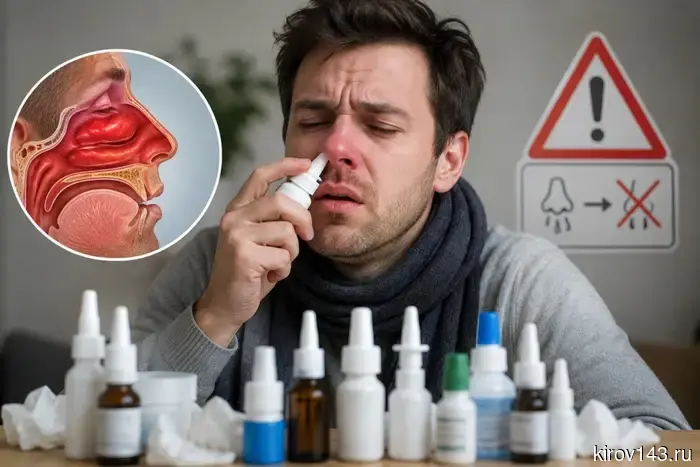
"To get hooked," like on a needle: the doctor explained why nasal drops can cause addiction.
How Drops Turn into a Trap
Topical decongestants are the most popular way to combat nasal congestion. They are used for colds, allergies, sinusitis, and even for preparing for medical examinations. The main advantages are speed of action, low cost, and availability without a prescription. However, as explained by Tatiana Nikolaevna Mironova, an associate professor at the Department of Polyclinic Therapy at Pirogov University’s Institute of Clinical Medicine, it is the uncontrolled use of these medications that has led to a widespread problem of addiction.
The mechanism is simple: there are alpha-adrenergic receptors in the nasal mucosa that are affected by vasoconstrictive components. With frequent and prolonged use, the receptors lose sensitivity, and the natural mechanisms of vasoconstriction become depleted. As a result, a paradoxical effect develops — instead of relief, congestion only worsens as soon as you stop using the drops.
Is it true that the longer you use them, the worse it gets?
Absolutely, confirms the expert. The optimal duration of use is no more than 5–7 days, a maximum of 10 days on a doctor's recommendation.
If these timeframes are ignored, the effectiveness of the medication decreases, and the risk of side effects increases.
How to recognize addiction: three signs
According to Tatiana Mironova, you can tell if you are already "hooked" on the drops by three signals.
You use the drops daily and regularly because your nose won’t breathe without them.
You have to increase the frequency of instillation — the previous dose stops helping, and congestion returns faster than before.
You cannot give up the bottle even with temporary improvement.
If all of this describes you, it’s about medication-induced rhinitis — one of the forms of chronic nasal congestion provoked by the drops themselves.
What are the dangers of prolonged use: from tachycardia to vision problems
Many think that the maximum harm from the drops is temporary discomfort. In reality, the list of systemic side effects is serious:
local consequences: impaired airway clearance (mucociliary clearance), "rebound" syndrome (increased swelling after discontinuation), persistent medication-induced rhinitis;
systemic effects: increased blood pressure, rapid heartbeat, heart rhythm disturbances, headaches, vision impairment.
The expert emphasizes that the likelihood of systemic side effects is higher with drops than with sprays — because they are harder to dose accurately, and part of the substance is inevitably swallowed.
Can you just stop using them?
Unfortunately, abrupt cessation often leads to painful congestion, insomnia, and a return to the bottle. Tatiana Mironova advises against self-medication and recommends consulting a doctor. A specialist will help gradually discontinue vasoconstrictive medications and will suggest alternative treatment methods — depending on the severity of the condition.
Recovery times are individual. Some people’s noses start to breathe on their own within a few days, while for others, the process may take weeks. The main thing is not to delay visiting an ENT specialist.
The main rule to avoid addiction
The safety formula is simple: vasoconstrictive drops are a "first aid" remedy, not a daily therapy. They should only be used as prescribed by a doctor and for a strictly limited time — 5–7 days, a maximum of 10.
If the congestion does not go away for longer, you need to look for the cause (allergy, deviated septum, chronic rhinitis) rather than keep instilling the drops over and over.
Другие Новости Кирова (НЗК)
 Александр Соколов провел деловую встречу с руководителем Свечинского округа.
Губернатор Кировской области Александр Соколов отметил, что в Свечинском муниципальном округе наблюдается положительная динамика. Он провел рабочую встречу с главой округа Галиной Гоголевой. Было отмечено, что за год доходы бюджета округа возросли на 25%, что в пять раз превышает предыдущие показатели.
Александр Соколов провел деловую встречу с руководителем Свечинского округа.
Губернатор Кировской области Александр Соколов отметил, что в Свечинском муниципальном округе наблюдается положительная динамика. Он провел рабочую встречу с главой округа Галиной Гоголевой. Было отмечено, что за год доходы бюджета округа возросли на 25%, что в пять раз превышает предыдущие показатели.
 In Kirov, a driver hit an elderly woman and fled.
In the past 24 hours, there have been two traffic accidents with casualties in the region — a rollover in the Slobodsky district and a pedestrian being hit in the regional center.
In Kirov, a driver hit an elderly woman and fled.
In the past 24 hours, there have been two traffic accidents with casualties in the region — a rollover in the Slobodsky district and a pedestrian being hit in the regional center.
 Обзор свежих новостей из регионов Кировской области.
Жители Афанасьевского района отправили пиломатериалы и маскировочные сети для бойцов СВО. В Омутнинском районе в рамках программы "Дорожный миллиард" была обновлена трасса Восточный - Филипповка. Подробности - в новостном обзоре из Кировской области. Бойцы беспилотных систем и артразведки на…
Обзор свежих новостей из регионов Кировской области.
Жители Афанасьевского района отправили пиломатериалы и маскировочные сети для бойцов СВО. В Омутнинском районе в рамках программы "Дорожный миллиард" была обновлена трасса Восточный - Филипповка. Подробности - в новостном обзоре из Кировской области. Бойцы беспилотных систем и артразведки на…
 В селе Архангельское Немского района заканчиваются работы по ремонту библиотеки имени Ожегова.
В селе Архангельское Немского района Кировской области подходит к концу ремонт центральной районной библиотеки имени Ожегова. Реконструкция начала проводиться в апреле. О состоянии выполнения работ расскажет Дарья Якименко. Здание, где расположена центральная районная библиотека имени Ожегова, было...
В селе Архангельское Немского района заканчиваются работы по ремонту библиотеки имени Ожегова.
В селе Архангельское Немского района Кировской области подходит к концу ремонт центральной районной библиотеки имени Ожегова. Реконструкция начала проводиться в апреле. О состоянии выполнения работ расскажет Дарья Якименко. Здание, где расположена центральная районная библиотека имени Ожегова, было...
 Более 200 многодетных семей Кировской области стали обладателями права на единое пособие, в котором им ранее было отказано.
Отделение Социального фонда в Кировской области пересмотрело ранее вынесенные отказы. Эти отказы получили семьи, чей средний доход на душу населения превышал прожиточный минимум не более чем на 10%. В результате пересмотра 223 многодетные семьи смогли получить право на единое пособие. Таким образом, им была предоставлена дополнительная финансовая помощь.
Более 200 многодетных семей Кировской области стали обладателями права на единое пособие, в котором им ранее было отказано.
Отделение Социального фонда в Кировской области пересмотрело ранее вынесенные отказы. Эти отказы получили семьи, чей средний доход на душу населения превышал прожиточный минимум не более чем на 10%. В результате пересмотра 223 многодетные семьи смогли получить право на единое пособие. Таким образом, им была предоставлена дополнительная финансовая помощь.
 A resident of the Murashinsky district was fined for fraud with social payments.
In the Murashinsky District of the Kirov Region, a verdict was issued in a case of illegal receipt of social benefits, the press service of the Kirov Region judicial system reported.
A resident of the Murashinsky district was fined for fraud with social payments.
In the Murashinsky District of the Kirov Region, a verdict was issued in a case of illegal receipt of social benefits, the press service of the Kirov Region judicial system reported.
"To get hooked," like on a needle: the doctor explained why nasal drops can cause addiction.
Vasoconstrictor drops are sold over the counter, are inexpensive, and provide instant relief for breathing. However, this convenience has a downside: millions of Russians cannot give up the bottle for years, and the nose stops breathing on its own.