
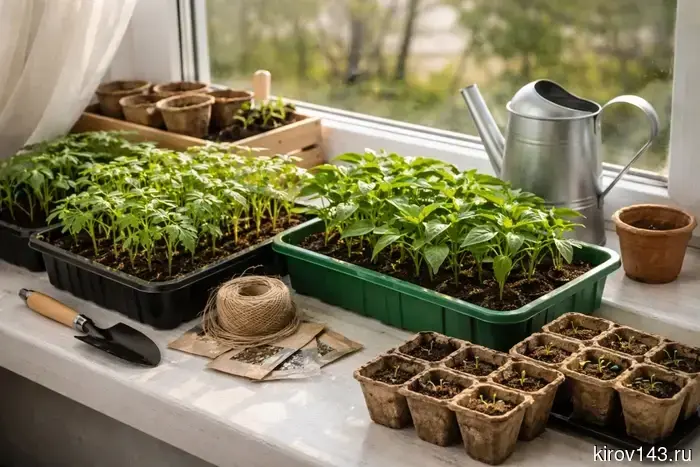
You still have time: what can be sown at the end of March without losing the harvest
Spring traditionally remains the most intense time: mistakes at the start can affect the outcome. However, experts note that in 2026, there is no need to rush — many vegetable crops are better sown right now, at the end of March or the beginning of April.
Soil and seeds: where to start with seedlings
Working with seedlings begins long before sowing. One of the key factors is the right soil.
Ready-made mixes are convenient, but most often based on peat, which dries out quickly and contains almost no nutrients. A more reliable option is to mix humus, sod, and leaf soil yourself. This soil retains moisture better and provides nutrition for the plants.
When choosing seeds, it is important to consider the climatic features of the region and the ripening times.
— Depending on the region, climatic conditions vary significantly, so it is necessary to focus on the duration of the agricultural season and take into account the ripening times of hybrids. Hybrids are generally more resistant to external conditions, diseases, and pests, and have higher yields, — quotes specialists mkset.ru.
Before sowing, it is recommended to disinfect the seeds and soil, for example, with a weak solution of potassium permanganate — this reduces the risk of diseases at early stages.
Light and temperature: growth conditions
In March and even in early April, plants often lack natural light. This leads to seedlings stretching.
Using phytolamps helps to compensate for the light deficiency.
— Thanks to their use, the green mass, leaf size, stem thickness, and root formation increase, — explains Victoria Erofeeva, head of the "Ecology" department at MTUSI, candidate of biological sciences.
The temperature regime is equally important. For tomatoes, a comfortable temperature is considered to be +18…+20 °C during the day and +16…+17 °C at night. Peppers require more heat — +22…+25 °C during the day and +18…+20 °C at night.
Watering and care
Watering should be moderate: excess moisture provokes diseases, while drying out slows growth.
— Containers for seedlings must have drainage holes so that excess moisture does not stagnate, — notes Azat Valitov, associate professor of plant growing, plant breeding, and biotechnology at BashGAU.
It is recommended to use settled water at room temperature or slightly warmer (+25–28 °C). Watering is best done in the morning hours.
Care regimes vary:
— tomatoes: moderate watering, light drying is allowed, feeding every 10–14 days; — peppers: regular watering without drying out, feeding every 7–10 days.
When to sow seedlings
Sowing dates remain the most discussed issue. Here it is important to consider not only the calendar but also the climate of the region.
In the central region, tomatoes are most often sown from mid-March. For open ground, sowing is permissible at the end of March or the beginning of April.
The optimal age of seedlings:
— tomatoes — 40–50 days; — peppers — 55–60 days.
If the deadlines have been missed, peppers and eggplants can be sown in early April, especially if it concerns early varieties.
Picking and hardening
In spring, the picking stage begins — transplanting seedlings into separate containers, which allows for a stronger root system to form.
Tomatoes are picked at the stage of 1–2 true leaves, burying them up to the cotyledons. Peppers — at the stage of 2–3 leaves, as carefully as possible and without deep burying.
The hardening stage before planting is no less important:
— tomatoes begin to harden 14–16 days before planting; — peppers — 10–12 days, avoiding drafts.
Common mistakes
The most common mistake is sowing too early.
It is believed that the earlier you plant seedlings, the faster the harvest will be. In practice, plants stretch out, become leggy, and tolerate transplanting worse.
The optimal age for tomato seedlings is 50–60 days. When planting at the end of May, it is better to plan sowing for the end of March or the beginning of April.
Peppers are more demanding on conditions: they tolerate picking worse, so they are often sown directly into separate containers and provided with regular feedings.
When to plant in the ground
Even strong seedlings will not yield results if planted too early.
In the central region, plants are planted in greenhouses in the first half of May, in open ground — from late May to early June, when the risk of frost is minimal.
Before planting, the soil must be prepared: it should be loose, warmed, and fertilized. In cold soil, plants slow down growth.
The main rule of the season
The main conclusion remains unchanged: haste rarely brings benefits.
It is much more important to correctly calculate the timing and create conditions for growth. Strong and compact seedlings take root faster and tolerate transplanting more easily, while overgrown plants adapt longer and yield less stable harvests.
For those who have not yet started sowing, there is no need to worry: the end of March and April is precisely the period when one can calmly engage in seedlings and lay the foundation for the future harvest.
Другие Новости Кирова (НЗК)
 Кировское «Динамо» потерпело поражение от пермского «Амкара».
Большой футбол снова появился в Кирове. После продолжительной серии выездных игр "Динамо" провело свой первый домашний матч. На стадионе ВятСШОР команда Виктора Булатова встречала пермский "Амкар". Роман Четвериков расскажет об этом подробнее. Для единственных представителей Приволжья в
Кировское «Динамо» потерпело поражение от пермского «Амкара».
Большой футбол снова появился в Кирове. После продолжительной серии выездных игр "Динамо" провело свой первый домашний матч. На стадионе ВятСШОР команда Виктора Булатова встречала пермский "Амкар". Роман Четвериков расскажет об этом подробнее. Для единственных представителей Приволжья в
 В Музее воинской славы состоялось открытие выставки «Помним Чернобыль».
В этом году исполняется 40 лет с момента аварии на Чернобыльской АЭС. Последствия взрыва на атомной станции ощущаются и по сей день. Герои, которые справлялись с последствиями катастрофы, навсегда остались в мировой истории. Из Кировской области было задействовано свыше трёх с половиной тысяч человек.
В Музее воинской славы состоялось открытие выставки «Помним Чернобыль».
В этом году исполняется 40 лет с момента аварии на Чернобыльской АЭС. Последствия взрыва на атомной станции ощущаются и по сей день. Герои, которые справлялись с последствиями катастрофы, навсегда остались в мировой истории. Из Кировской области было задействовано свыше трёх с половиной тысяч человек.
 Pensions will increase, debts will be limited, and installment payments will be cut: what will change in the lives of Russians from April 1.
Starting in April, several notable changes will come into effect in Russia.
Pensions will increase, debts will be limited, and installment payments will be cut: what will change in the lives of Russians from April 1.
Starting in April, several notable changes will come into effect in Russia.
 The prosecutor's office returned 427 thousand to the pensioner from Shabalino.
Money disappeared from the account of a pensioner from the Kirov region and was found with a Muscovite.
The prosecutor's office returned 427 thousand to the pensioner from Shabalino.
Money disappeared from the account of a pensioner from the Kirov region and was found with a Muscovite.
 As a result of the "Silver Constellation" competition, 21 projects will receive support.
The results of the annual grant competition "Silver Constellation - 2026" have been summarized, which is held at the initiative of State Duma deputy Rahim Azimov in collaboration with the Kirov regional organization "Knowledge."
As a result of the "Silver Constellation" competition, 21 projects will receive support.
The results of the annual grant competition "Silver Constellation - 2026" have been summarized, which is held at the initiative of State Duma deputy Rahim Azimov in collaboration with the Kirov regional organization "Knowledge."
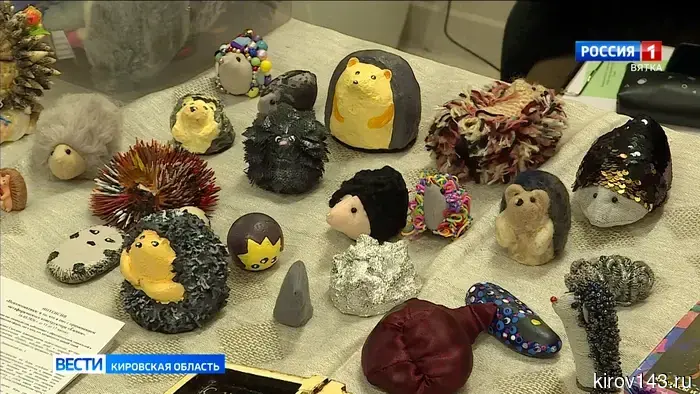 В Кирове впервые отпраздновали «День ежей».
Весна — это период, когда природа пробуждается, и вместе с ней те, кто зимовал в спячке. Среди них - любимые персонажи детских сказок, колючие стражи лесных тайн - ежи. В Кирове впервые состоялся новый семейный праздник - День ежей. Посетители наслаждались коллекциями картин и игрушек, а также гладили живых африканских...
В Кирове впервые отпраздновали «День ежей».
Весна — это период, когда природа пробуждается, и вместе с ней те, кто зимовал в спячке. Среди них - любимые персонажи детских сказок, колючие стражи лесных тайн - ежи. В Кирове впервые состоялся новый семейный праздник - День ежей. Посетители наслаждались коллекциями картин и игрушек, а также гладили живых африканских...
You still have time: what can be sown at the end of March without losing the harvest
The end of March is not a reason to delay planting. Even if some deadlines have been missed, gardeners still have the opportunity to calmly start the season without losing their harvest. Moreover, for a number of crops, this period is considered optimal.