

Is it worth running from the gasoline crisis to the outlet?
Russians, frightened by fuel shortages, are increasingly looking towards alternatives. According to analysts from the Migtorg platform, in June, the number of transactions for the purchase of hybrids and electric vehicles increased by 30% compared to May, and their average price jumped from 1.39 to 1.71 million rubles. Chinese brands occupy more than 75% of the "green" car market, with the Zeekr 001 becoming the most popular electric vehicle. Dealers, in turn, report a 2.7-fold increase in sales of plug-in hybrids compared to last year. But is life with a socket instead of a gas tank really so cloudless? To find out, we spoke with those who have long stopped looking at gas station price tags.
Expert and owner opinions
The first interviewee was Albert Bikaluk, a deputy of the Legislative Assembly. He has owned an electric vehicle for almost five years and believes that the main advantage is savings. "In summer, the cost difference per kilometer compared to a gasoline engine is 8-10 times," he says. The second interviewee is Vadim Fedotov, a master of sports and two-time champion of Russia in rally raids in the T3 class. His electric car produces 550 horsepower, and the arithmetic is even clearer for him. "On my car, 100 km costs about 450 rubles," Fedotov calculates. "If you take gasoline at 109 rubles and a consumption of 20 liters per hundred, it comes out to 2,180. The savings are one and a half thousand rubles for every 100 km." At the same time, servicing an electric car is many times cheaper: Fedotov's maintenance costs 8-10 thousand once a year, while oil changes on a gasoline foreign car cost 15-20 thousand twice a year.
Battery: not a phone and not a bomb
One of the main fears is battery degradation. Many compare it to a smartphone, which loses capacity after a couple of years. Albert Bikaluk disagrees: "My car is almost 5 years old, with a mileage of 36,000. I don't see any loss of capacity. Manufacturers provide a warranty of up to 200,000 km. Replacing the battery costs around 5-10 thousand dollars, but if you add up all the expenses for a gasoline car over this period, it will be comparable, if not more expensive." Fedotov adds: the warranty on the battery is 8 years. At the same time, he warns against cheap repairs. "All the scary videos of burning electric cars are the consequences of amateur battery openings after accidents," explains the champion. "It's like taking a nail and sticking it into a phone battery. If you don't mess with it with crooked hands, everything works as it should."
Winter and highway: there are nuances
In winter, the range decreases. Bikaluk says that in summer it lasts him a week, in winter — 2-3 days. However, comfort is at its peak: "Half a minute before leaving, I press a button — and the car is warm: the seat, steering wheel, and windows are defrosted. Nothing needs to be warmed up." Long trips are more complicated. Fedotov believes that on popular routes (Kazan, Moscow), the infrastructure already allows for calm travel. Charging stations are even available next to regular gas stations. "Travel time increases by 40-60 minutes, but this is an opportunity to have lunch, take a walk, or rest," he reflects. Bikaluk is more cautious: "If there were a network of fast chargers like abroad, it would be no problem. But since there aren't that many, sometimes you have to wait for another car to charge. I don't travel on it."
What’s the bottom line?
Both experts agree on the main point: an electric vehicle is the future, and savings on fuel and maintenance are real. But it requires thoughtful route planning. "Buy electric cars," Bikaluk smiles. "We will all switch."
And what about Kirov?
However, the main question for most Kirov residents is price. How much do new and used electric vehicles cost in Kirov today, and what does the buyer get for that money? We studied offers from dealers and popular classifieds to understand what the local market looks like now. If a few years ago the choice of electric vehicles in Kirov was limited to just a few models, today the situation has changed significantly. There are both budget cars with mileage costing less than a million rubles and new premium crossovers priced close to 10 million rubles. Moreover, they differ not only in price but also in the philosophy of use.
Up to one million rubles
The lower price limit in the secondary market is held by the Nissan Leaf. This model remains the most popular electric vehicle in Russia, including Kirov. First-generation cars can be found for about 800-900 thousand rubles. However, buyers should understand that such a price is due to the age of the car and its limited range. Typically, these are cars from 2015-2017 with batteries that have already partially lost capacity. Such a car is primarily suitable for the city: daily trips to work, shopping, or errands. For long-distance travel, it is significantly less suitable. Essentially, for this money, a person buys the opportunity to avoid daily gasoline expenses but has to deal with compromises in the form of limited range, less modern equipment, and older technology.
From 2 to 3 million rubles
The market looks completely different in the range of two to three million rubles. Here, modern Nissan Leafs with an increased battery, Russian Evolute, Chinese Zeekr X, some versions of Tesla, as well as hybrid models begin to appear. This price range can be considered the most interesting for the average buyer today. For this money, the car already offers a significantly greater range, modern safety systems, 360-degree cameras, adaptive cruise control, a quality multimedia system, fast charging, and a more comfortable interior. While the first Leafs can be considered a way to save on fuel, cars costing 2-3 million rubles begin to compete with conventional gasoline crossovers not only in terms of operating costs but also in terms of comfort level.
From 4 million and above
After the mark of about four million rubles, the very meaning of the purchase changes. If in the budget segment the main goal is savings on operation, then expensive models offer completely different advantages. Here, buyers are offered large family crossovers with premium finishes, huge multimedia screens, air suspension, seat massage, semi-autonomous driving systems, hundreds of horsepower, and impressive acceleration. Popular models today in this category include Li Auto, Zeekr 001, ROX 01, Deepal G318, and other modern Chinese cars. Many of them are not pure electric vehicles but series hybrids. The gasoline engine does not directly drive the car but works as a generator, charging the battery. As a result, the range is measured not in hundreds but almost in thousands of kilometers, and the problem of finding charging stations becomes less relevant.
Why is the price range so large?
The difference of almost nine million rubles is explained by several factors. First, the age of the vehicles. The secondary market sells cars that are almost ten years old, while new models have just appeared for sale. Second, the battery capacity. The larger the battery, the further the car can travel without recharging, and the battery remains the most expensive part of any electric vehicle. Third, the level of equipment. While budget models offer the necessary minimum of functions, expensive cars effectively become high-tech gadgets on wheels with a large number of electronic assistants. Finally, the origin of the vehicles plays a role. Today, the Kirov market is almost entirely shaped by Chinese manufacturers. They offer the widest variety of models — from relatively affordable family crossovers to premium-class vehicles costing almost 10 million rubles.
What market has formed in Kirov?
Even from the studied offers, it is clear that the electric vehicle market in Kirov has ceased to be an exotic niche. Buyers can choose both an inexpensive city electric car costing less than a million rubles and a modern technological vehicle with a large range, comparable in equipment level to premium European brands. At the same time, the main conclusion remains simple: the cheaper the electric vehicle, the more compromises the buyer will have to accept — primarily regarding range and the age of the car. The higher the price, the less the buyer thinks about saving on gasoline and the more they acquire a modern level of comfort, technology, and opportunities for long trips. This resonates particularly well with the opinions of electric vehicle owners, who note that today the choice of such cars is no longer just a matter of savings but also a matter of convenience for everyday use.
Другие Новости Кирова (НЗК)
 ВТБ оказал поддержку новой экранизации романа «Война и мир», созданной режиссёром Сергеем Урсуляком.
ВТБ оказал поддержку новой адаптации романа «Война и мир» под руководством режиссёра Сергея Урсуляка.
ВТБ оказал поддержку новой экранизации романа «Война и мир», созданной режиссёром Сергеем Урсуляком.
ВТБ оказал поддержку новой адаптации романа «Война и мир» под руководством режиссёра Сергея Урсуляка.
 В Юрье запустилось «Отличное место»: новое молодежное пространство сможет объединить свыше двух тысяч человек.
В Юрье запустилось «Отличное место»: новое молодежное пространство сможет объединить свыше двух тысяч человек.
В Юрье запустилось «Отличное место»: новое молодежное пространство сможет объединить свыше двух тысяч человек.
 Для Мурыгино будет разработан план развития до 2036 года.
Произошел рабочий визит представителей правительства Кировской области и депутатов Законодательного Собрания в поселок Мурыгино, который объявлен региональной точкой роста. Несколько недель назад губернатор Александр Соколов, находясь с рабочей поездкой в Юрьянском районе, дал задание разработать план развития.
Для Мурыгино будет разработан план развития до 2036 года.
Произошел рабочий визит представителей правительства Кировской области и депутатов Законодательного Собрания в поселок Мурыгино, который объявлен региональной точкой роста. Несколько недель назад губернатор Александр Соколов, находясь с рабочей поездкой в Юрьянском районе, дал задание разработать план развития.
 В Оричевском районе 52-летний велосипедист попал под колеса КАМАЗа.
По предварительным данным, дорожно-транспортное происшествие произошло 8 июля 2026 года в Оричевском районе, в поселке городского типа Стрижи на улице Новой, 29А. В данном инциденте 37-летний водитель КАМАЗа сбил 52-летнего велосипедиста, который получил травмы. В настоящее время проводится проверка по факту ДТП, выясняются причины и обстоятельства случившегося.
В Оричевском районе 52-летний велосипедист попал под колеса КАМАЗа.
По предварительным данным, дорожно-транспортное происшествие произошло 8 июля 2026 года в Оричевском районе, в поселке городского типа Стрижи на улице Новой, 29А. В данном инциденте 37-летний водитель КАМАЗа сбил 52-летнего велосипедиста, который получил травмы. В настоящее время проводится проверка по факту ДТП, выясняются причины и обстоятельства случившегося.
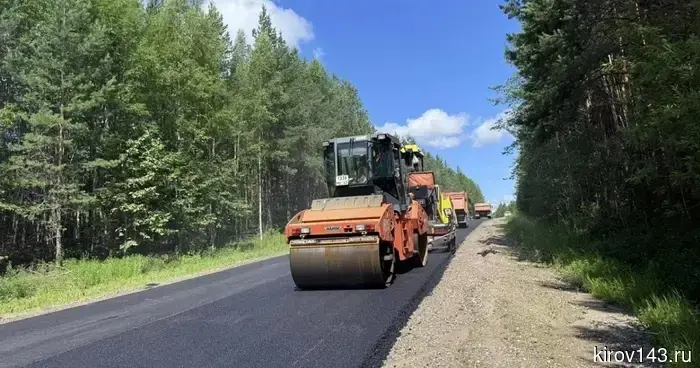 Благодаря национальному проекту проводится ремонт дороги Омутнинск – Песковка – Кирс.
Благодаря национальному проекту осуществляется ремонт дороги Омутнинск – Песковка – Кирс.
Благодаря национальному проекту проводится ремонт дороги Омутнинск – Песковка – Кирс.
Благодаря национальному проекту осуществляется ремонт дороги Омутнинск – Песковка – Кирс.
 Представители топливных компаний Кировской области поделились информацией о нынешней ситуации с бензином.
Александр Соколов провел первое заседание оперативного штаба, посвященное обеспечению Кировской области топливом. Губернатор отметил, что в регионе сформирован двухнедельный запас топлива. Новые партии находятся в пути, и поставки продолжаются. В целом в стране происходит реорганизация логистики доставки топлива.
Представители топливных компаний Кировской области поделились информацией о нынешней ситуации с бензином.
Александр Соколов провел первое заседание оперативного штаба, посвященное обеспечению Кировской области топливом. Губернатор отметил, что в регионе сформирован двухнедельный запас топлива. Новые партии находятся в пути, и поставки продолжаются. В целом в стране происходит реорганизация логистики доставки топлива.
Is it worth running from the gasoline crisis to the outlet?
The fuel crisis is radically changing the market: in a month, sales of "green" cars have increased by 30%. We interviewed two electric car owners to clarify the myths and real advantages, and studied the market in Kirov — how much new and used electric cars cost and what characteristics can be obtained for this money. Together, we answer the main question: what does the consumer actually get?