
The Supreme Court clarified when unauthorized construction cannot be demolished without a court order and compensation.
The Presidium of the Supreme Court of Russia, led by Igor Krasnov, has approved a review of judicial practice regarding disputes related to unauthorized construction. The document contains several key guidelines for lower courts and local authorities, reports the publication "Russian Gazette."
One of the most important clarifications concerns extensions to apartment buildings. Local administrations do not have the authority to demolish such structures out of court — corresponding decisions are exclusively within the jurisdiction of the courts. At the same time, judicial instances are instructed to verify the justification for classifying the object as unauthorized construction at every stage of the case review.
Furthermore, the Supreme Court indicated that the demolition of a building is unacceptable if the issue with the citizens living in that house has not been resolved beforehand. This rule is aimed at protecting the housing rights of people whose interests may be affected.
A separate block of provisions concerns bona fide developers. The review provides a specific example: the owner of a house obtained all necessary permits, and the information about encumbrances was absent in the Unified State Register of Real Estate and the urban planning plan. However, it later turned out that the building is located near a gas pipeline. In such a case, as indicated by the Supreme Court of the Russian Federation, the object is subject to demolition, but the owner has the right to demand compensation.
At the same time, the Supreme Court confirmed that not all objects can be legalized in principle. Construction on agricultural land with illegally changed categories is prohibited, as well as the erection of block construction houses on plots designated for gardening.
An expert interviewed by the publication reminded of three conditions for recognizing ownership rights to unauthorized construction through the court: the presence of rights to the plot allowing for the construction of this object, compliance of the building with established requirements on the day of filing in court, and the absence of violations of the rights of third parties and threats to their life and health. At the same time, judicial legalization is an exceptional means of protection, applied only in the absence of signs of obvious bad faith behavior on the part of the plaintiff. If the developer merely simulated attempts to obtain permission, acting in violation of the law, the court has the right to refuse to satisfy the claim.
Другие Новости Кирова (НЗК)
 A participant in the special military operation will be assisted by the court in obtaining new housing instead of the burned-down house.
The Prosecutor's Office of the Opalinsky District achieved a court decision to provide improved housing for a participant in the special military operation, whose house was recognized as emergency after a fire.
A participant in the special military operation will be assisted by the court in obtaining new housing instead of the burned-down house.
The Prosecutor's Office of the Opalinsky District achieved a court decision to provide improved housing for a participant in the special military operation, whose house was recognized as emergency after a fire.
 Житель Ростова-на-Дону, обманувший кировчанку, должен будет ответить перед судом.
Кировские полицейские арестовали 20-летнего киберпреступника из Ростова-на-Дону. Подробности сообщили в пресс-службе регионального Управления МВД. По информации правоохранителей, молодой человек купил у неустановленного лица приложение для удалённого контроля над чужими мобильными телефонами. С помощью этого приложения...
Житель Ростова-на-Дону, обманувший кировчанку, должен будет ответить перед судом.
Кировские полицейские арестовали 20-летнего киберпреступника из Ростова-на-Дону. Подробности сообщили в пресс-службе регионального Управления МВД. По информации правоохранителей, молодой человек купил у неустановленного лица приложение для удалённого контроля над чужими мобильными телефонами. С помощью этого приложения...
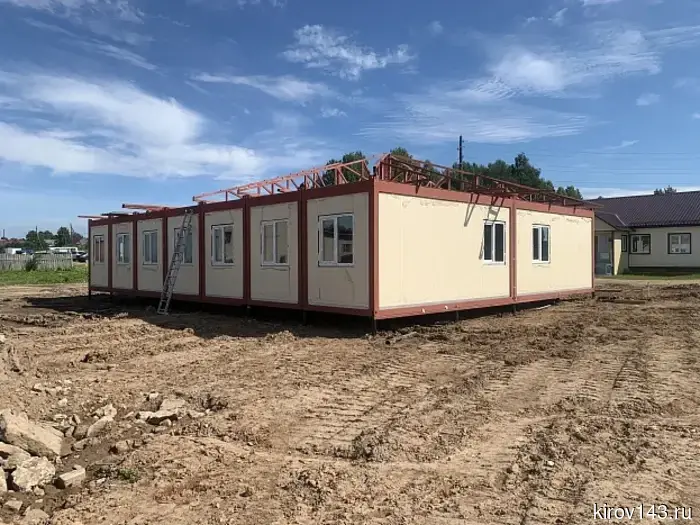 В Кировской области строится 51 новый фельдшерско-акушерский пункт.
В рамках нового этапа программы обновления первичного звена здравоохранения нацпроекта «Продолжительная и активная жизнь» для жителей еще 51 населенного пункта в 21 районе области будут установлены новые фельдшерско-акушерские пункты (ФАПы): Арбажском, Афанасьевском, Белохолуницком, Верхнекамском,
В Кировской области строится 51 новый фельдшерско-акушерский пункт.
В рамках нового этапа программы обновления первичного звена здравоохранения нацпроекта «Продолжительная и активная жизнь» для жителей еще 51 населенного пункта в 21 районе области будут установлены новые фельдшерско-акушерские пункты (ФАПы): Арбажском, Афанасьевском, Белохолуницком, Верхнекамском,
 В Роспотребнадзоре объяснили, какие заболевания ребенок может подхватить, играя в песочнице.
Лето — это теплый и приятный период, когда можно приятно провести время на солнце, отправив ребенка поиграть с другими детям в песочнице во дворе. Однако, как считают специалисты Роспотребнадзора, такое, казалось бы, безопасное место скрывает множество опасностей. Ребенок может принести оттуда ОРВИ, заразиться глистами и
В Роспотребнадзоре объяснили, какие заболевания ребенок может подхватить, играя в песочнице.
Лето — это теплый и приятный период, когда можно приятно провести время на солнце, отправив ребенка поиграть с другими детям в песочнице во дворе. Однако, как считают специалисты Роспотребнадзора, такое, казалось бы, безопасное место скрывает множество опасностей. Ребенок может принести оттуда ОРВИ, заразиться глистами и
 В Кировской области контролируют популяцию волков.
В Кировской области проводится работа по контролю за популяцией волков, сообщили в областном правительстве. Охотники, государственные инспекторы и пользователи охотничьих угодий следят за ситуацией в населенных пунктах и организуют мероприятия по уменьшению числа хищников, если они появляются рядом с населением. Согласно информации
В Кировской области контролируют популяцию волков.
В Кировской области проводится работа по контролю за популяцией волков, сообщили в областном правительстве. Охотники, государственные инспекторы и пользователи охотничьих угодий следят за ситуацией в населенных пунктах и организуют мероприятия по уменьшению числа хищников, если они появляются рядом с населением. Согласно информации
 Житель Ростова-на-Дону, обманувший кировчанку, будет судим.
Кировские полицейские задержали 20-летнего киберафериста из Ростова-на-Дону. Пресс-служба регионального Управления МВД поделилась подробностями. По информации правоохранительных органов, молодой человек купил у незнакомца приложение для удалённого управления чужими мобильными телефонами. С его помощью…
Житель Ростова-на-Дону, обманувший кировчанку, будет судим.
Кировские полицейские задержали 20-летнего киберафериста из Ростова-на-Дону. Пресс-служба регионального Управления МВД поделилась подробностями. По информации правоохранительных органов, молодой человек купил у незнакомца приложение для удалённого управления чужими мобильными телефонами. С его помощью…
The Supreme Court clarified when unauthorized construction cannot be demolished without a court order and compensation.
Authorities will no longer be able to unilaterally demolish extensions to apartment buildings, and courts are required to verify whether the object is unauthorized. The Supreme Court of the Russian Federation also protected the rights of bona fide developers whose buildings were subject to demolition due to previously unknown encumbrances.