
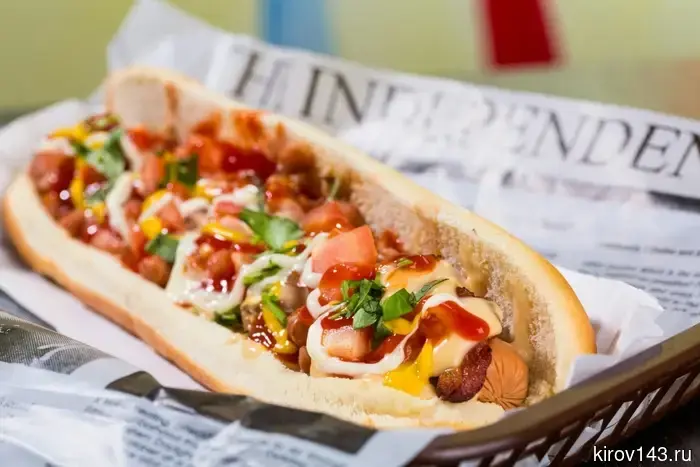
Hot Myth: Why a Hot Dog with Preservatives Does Not Guarantee Safety
With the arrival of July heat, Moscow traditionally divides into two camps: those who bravely stand by the stove and those who seek refuge in street fast food. Social media periodically features assurances that hot dogs are almost the only street food you can trust in thirty-degree heat. The argument sounds logical: after all, there are so many preservatives and stabilizers in sausages and sauces that they simply don't have time to spoil. But medical experts urge caution.
As specialists explain, preservatives can indeed slow the reproduction of certain bacteria and extend the shelf life of products. However, this property only works as long as the product is in airtight packaging. Once the bun is cut, the sauce is applied, and the sausage is removed from heat treatment, the situation changes dramatically.
According to a nutritionist from INVITRO, the main threat in the heat lies not even in the product's composition but in how it was stored and prepared. If ingredients sit out in the sun without refrigeration for too long, they become an ideal breeding ground for bacteria, and no preservatives will stop this process. Moreover, even if the sausage is then heated well, this will not destroy the toxins that microorganisms have already released during improper storage. Preservatives also do not protect against recontamination if the seller has violated basic hygiene rules at the point of sale.
Experts indicate that mayonnaise-based sauces represent a particular risk zone—they spoil the fastest and become breeding grounds for bacteria. The bun also quickly becomes soggy in the heat and can start to ferment or develop mold, while fresh vegetables, if cut in advance, turn into a nutrient medium for E. coli if left out for too long.
Interestingly, some experts consider hot dogs to be slightly safer than shawarma or burgers due to the fewer perishable ingredients. However, gastroenterologists categorically disagree and rank all these dishes equally in terms of danger in the heat.
Nevertheless, buyers have the opportunity to reduce risks if they know what to pay attention to. Medical professionals advise checking the appearance of the sausage—it should be smooth and dry, without stickiness or roughness. The bun should not have dark spots or mold, and the sauce should not have a sour smell or an unnatural yellowish tint.
At the same time, doctors warn about a common trick: if a hot dog is served too hot, it may be an attempt by the seller to hide an unsatisfactory product with strong heating. It’s also worth observing the point of sale itself: the presence of refrigeration equipment, cleanliness of surfaces, and the seller's adherence to hygiene are important markers that should not be ignored.
The main rule that experts remind us of is extremely simple: in the heat, any product that has been left out in the open for more than two hours becomes potentially dangerous. Hot dogs, despite their "chemical protection," are no exception to this rule. Therefore, relying on preservatives as a guarantee of safety in the summer heat is at least shortsighted.
Другие Новости Кирова (НЗК)
 A dead employee of the Russian Railways was found at the station in Kotelnich.
An investigation has begun in Kotel'nich into an accident that resulted in the death of an employee of OAO "RZD".
A dead employee of the Russian Railways was found at the station in Kotelnich.
An investigation has begun in Kotel'nich into an accident that resulted in the death of an employee of OAO "RZD".
 A dead employee of the Russian Railways was found at the station in Kotel'nich.
In Kotelnich, an investigation has begun into an accident that resulted in the death of an employee of JSC "Russian Railways".
A dead employee of the Russian Railways was found at the station in Kotel'nich.
In Kotelnich, an investigation has begun into an accident that resulted in the death of an employee of JSC "Russian Railways".
 Кировские спортсмены по конькобежному спорту приступили к подготовке к новому сезону.
До первых соревнований еще есть время, но расслабляться не стоит. На стадионе «Динамо» у конькобежцев идет интенсивная подготовка. Вместе с юниорами к новому сезону готовится и ведущий спортсмен кировской команды Данил Смирнов. Наша съемочная группа посетила одну из тренировок. Здесь нет места
Кировские спортсмены по конькобежному спорту приступили к подготовке к новому сезону.
До первых соревнований еще есть время, но расслабляться не стоит. На стадионе «Динамо» у конькобежцев идет интенсивная подготовка. Вместе с юниорами к новому сезону готовится и ведущий спортсмен кировской команды Данил Смирнов. Наша съемочная группа посетила одну из тренировок. Здесь нет места
 After the cool front, heat up to +30 will return to the Kirov region.
The cold front currently passing through the Kirov region is already leaving the area. Meteorologists predict a quick warming and the return of heat.
After the cool front, heat up to +30 will return to the Kirov region.
The cold front currently passing through the Kirov region is already leaving the area. Meteorologists predict a quick warming and the return of heat.
 The passage of Lermontov will be repaired in Kirov-Chepetsk.
The work has already begun.
The passage of Lermontov will be repaired in Kirov-Chepetsk.
The work has already begun.
 В Нововятске будет создана площадка для прохождения норм ГТО.
В этом году на набережной Тренера Пушкарева в Нововятском районе Кирова создадут спортивную площадку для выполнения нормативов ГТО. Об этом информировала администрация областного центра. Работы будут проведены в рамках государственной программы «Развитие физической культуры и спорта». К началу года планируется обустройство детских и спортивных площадок.
В Нововятске будет создана площадка для прохождения норм ГТО.
В этом году на набережной Тренера Пушкарева в Нововятском районе Кирова создадут спортивную площадку для выполнения нормативов ГТО. Об этом информировала администрация областного центра. Работы будут проведены в рамках государственной программы «Развитие физической культуры и спорта». К началу года планируется обустройство детских и спортивных площадок.
Hot Myth: Why a Hot Dog with Preservatives Does Not Guarantee Safety
In the summer heat, a street hot dog seems like a lifesaver — quick, filling, and, as they say online, safe due to preservatives. However, doctors dispel this misconception: preservatives only work on the store shelf, while other factors determine everything at the vendor's stand.