
The road to the sunrise
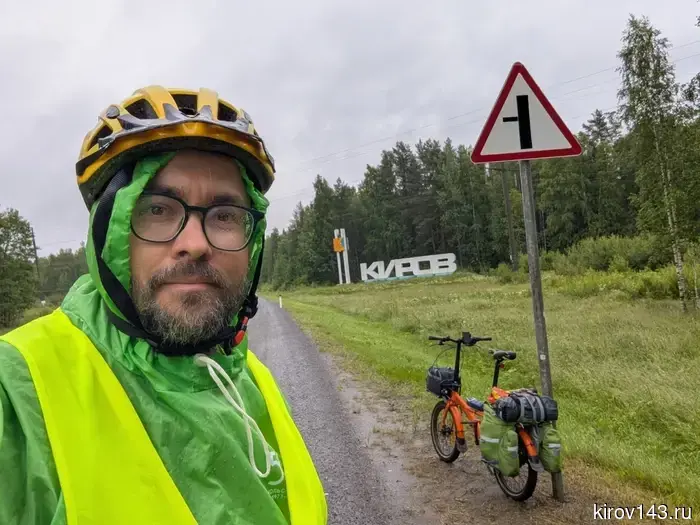
We met late in the evening, literally an hour after Ilya had traveled 50 km in pouring rain and, completely soaked, stopped at a local hotel on the outskirts. At the reception, I was greeted by a completely exhausted, slightly unshaven, thin man in sportswear, a T-shirt, and thin "hotel" slippers. In those same slippers, he walked down the wet street to the nearest café, where we agreed to sit and have tea.
Ilya himself is from St. Petersburg, and after a quick glance at the local menu, he was surprised by the prices: "We can get mashed potatoes for 50-60 rubles, here it's 150... And you can't say it's 'the backcountry.'"
"We're probably the backcountry by all indicators, except for the prices in establishments," I jokingly added.
After laughing at the "Moscow" prices in Kirov, I asked how it all started.
"For a while, I worked as a journalist, then I went remote and somewhere in 2019 I decided that I was fed up with everything — I would quit and hitchhike across Russia. At the same time, I would participate in some volunteer projects. Although I had never done volunteering before. I became interested in the philosophy of this phenomenon itself. You get used to doing something for money, but here there is no such 'response,' it's different here.
The first project was Valaam. The second was Baikal, already ecological. There we were involved in cleaning up trash and educational work with the local population. It was amusing to observe the locals' reactions when you tell them that if you bury bags of trash, they don't just disappear by themselves. In fact, it was a great experience; it changes your perception."
Here we took a short break. Ilya noted that periodically, of course, the desire to give everything up hits. Especially when you don't get enough response and due to external circumstances, when it seems like everything is against you. Like this constant downpour.
"Kirov region now only associates with rain and unpredictable weather," the man noted as he started dinner.
The longer we talked, the more noticeable Ilya changed. Tired and almost emaciated, he literally perked up as soon as the conversation turned to his work and the impact it has on people. In every region, in every city, there are those willing to help. Over 28 days of travel, he met a large number of people, visited farms, a sanatorium, and the "Children-Angels" center in Sharya — a rehabilitation center for children with disabilities, which the parents of special children created themselves with the help of grants.
"After Baikal, I realized that I wanted to go in this direction. The third project was a rehabilitation camp for children called 'Sheredary.' I got there in the fall. I saw children and teenagers with cancer and other serious illnesses who were in remission and undergoing psychological rehabilitation. That is, they had already recovered and were going through the recovery stage.
This experience became defining for me. I realized that it's really cool to engage in volunteering. Not because you get something, but because you consider it truly important."
For many to this day, charity is perceived as a "sacrifice," as if when you do something good for others on a voluntary basis, you are depriving yourself of something. Ilya said about this: "Many perceive what I do as if I suffer for it, giving my last, but that's not the case. I came to the same 'Sheredary' because it's really very interesting and cool. The guys are great, and through them, you learn something yourself."
Speaking about people's attitudes towards children and adults with disabilities, you almost always encounter embarrassment, detachment, almost fear of "touching" this issue. The mindset of our ancestors that "they didn't exist before, and if they did, they weren't shown" has ingrained itself in the consciousness of current generations.
Agree, it's always uncomfortable when you see an overtly pity-inducing advertisement with a baby who has been in hospitals since birth, with the caption "FUNDRAISING." And here the question is not about people's reactions, but about the perception of disabled people as those who will be helped by public "pity."
"One of my goals is to show and try to change the strange attitude towards charity in Russia, at least a little. Here it seems like you are some kind of sacrificial altar, a sufferer, putting a cross on yourself: 'I am for children with cancer, I will suffer for them!' But it's not about pity and personal suffering at all. You do this also for yourself. It feels good to realize that I am doing this."
Returning to the beginning of the journey and how the idea for the "Road to the Rising Sun" project came about, Ilya Schultz shared how it all started.
"Well, I got into this 'Sheredary' center, started going there regularly. I had a music class for children. There were also various courses for volunteers where they talked about hospices. This topic caught my attention. I thought: 'What is it like for those who won't recover?' It's much harder for the kids there to find motivation after being told 'you have two months left.' And hospices need support — financial primarily, for pain relief, doctors, maintenance. That's how I 'went' into my first project — walking from Moscow to St. Petersburg. I raised about 240,000 rubles for the 'Vera' foundation in 50 days.
The next year, I did a project for myself — I was cycling from St. Petersburg to Teriberka. People also responded, supported, helped. I really liked it, and then, two years later, I thought I should combine cycling and a charitable project. That's how this idea was born."
Ilya Schultz started the "Road to the Rising Sun" project on June 1. The starting point is Moscow. Where the project will end is unknown.
"The main difference from previous projects is that I have no destination here. I thought there is a philosophy in this. You ride as if into the unknown. It's about trusting the world, perhaps the Universe."
At the very beginning, the volunteer announced that the goal of the project is to raise funds for the hospice "House with a Lighthouse."
"House with a Lighthouse" is a charitable foundation that helps children and young adults. As stated on the foundation's official website: "This is help for children and young adults who cannot be cured, but to whom warmth and care can be given. Here, it doesn't matter how much time is left, what matters is how today's day goes."
The funds raised during the journey will go towards:
- the foundation's projects
- the work of the hospice's outreach service, which allows severely ill children and young adults to live at home surrounded by loved ones
- the work of the respiratory service, which helps patients with breathing difficulties live in their own homes rather than in a hospital.
We talked for an hour and a half. It was already dark outside, and the rain finally subsided. Ilya noticeably brightened as he spoke about his meetings and how in every city there is someone ready to help — some with money, some with shelter, some just with kind words.
We said goodbye at the entrance to the hotel. On Monday, June 29, Ilya will spend in Kirov — he will rest, tidy up his bike, and recover a bit after a rainy week. After that, his path leads towards Perm — he plans to reach there by July 5-7. Ahead are still thousands of kilometers, new cities, new meetings.
How to help: the link to the fundraising is available in Ilya Schultz's social media profile.
Другие Новости Кирова (НЗК)
 In Bashkortostan and Yakutia, restrictions on fuel sales have been introduced.
The authorities reported on the measures taken.
In Bashkortostan and Yakutia, restrictions on fuel sales have been introduced.
The authorities reported on the measures taken.
 No one was injured in the fire at the OCM factory.
The company commented on yesterday's incident.
No one was injured in the fire at the OCM factory.
The company commented on yesterday's incident.
 In Bashkortostan and Yakutia, restrictions have been introduced on the sale of fuel.
The authorities reported on the measures taken.
In Bashkortostan and Yakutia, restrictions have been introduced on the sale of fuel.
The authorities reported on the measures taken.
 The Belokholunitsky district will take a loan of 35 million.
The authorities are looking for a credit organization.
The Belokholunitsky district will take a loan of 35 million.
The authorities are looking for a credit organization.
 Seven graduates from the Kirov region scored 100 points on the Unified State Exam.
The results of the Unified State Exam in geography, biology, computer science, and foreign languages have become known in the Kirov region.
Seven graduates from the Kirov region scored 100 points on the Unified State Exam.
The results of the Unified State Exam in geography, biology, computer science, and foreign languages have become known in the Kirov region.
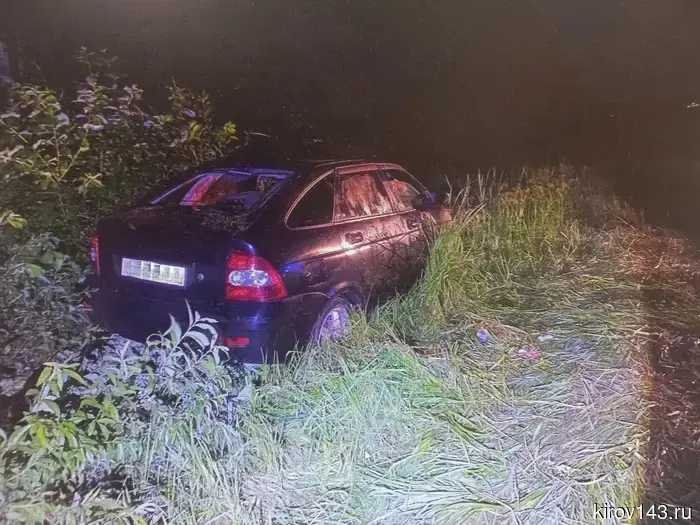 В Слободском районе случилась авария с участием лося.
С 26 по 28 июня 2026 года в Кировской области зарегистрировано 8 дорожно-транспортных происшествий, в результате которых 10 человек получили травмы, сообщила региональная Госавтоинспекция. По предварительным данным, одно из ДТП произошло 26 июня в Слободском районе на 618 км федеральной дороги «Кострома – Шарья – Киров».
В Слободском районе случилась авария с участием лося.
С 26 по 28 июня 2026 года в Кировской области зарегистрировано 8 дорожно-транспортных происшествий, в результате которых 10 человек получили травмы, сообщила региональная Госавтоинспекция. По предварительным данным, одно из ДТП произошло 26 июня в Слободском районе на 618 км федеральной дороги «Кострома – Шарья – Киров».
The road to the sunrise
Volunteer Ilya Schultz has arrived in Kirov. He started his charitable bike ride "Road to the Rising" almost a month ago — on June 1. On the 27th day of this journey, he found himself in one of Kirov's hotels, greeted and soaked by the chilly rain.