

"The rise in fuel prices could quickly drive up inflation": experts on the market situation
As is known, recently the Russian fuel market has been going through tough times. In many regions, restrictions on fuel sales, particularly gasoline, have been introduced, and there has also been a sharp rise in prices (this is currently being addressed by the Federal Antimonopoly Service). The authorities attribute the situation to disruptions in the operation of several oil refineries due to drone attacks and other issues.
We decided to ask analysts how this entire situation will affect the economic life of the country. In particular, how it will influence (if it does) the exchange rate of the ruble, inflation and inflation expectations, monetary policy, and other areas.
According to experts, the ruble has noticeably weakened recently, but this has not happened due to fuel problems, but for other reasons. The fuel crisis may have an additional impact on the exchange rate in the future.
Analysts also believe that the sharp rise in fuel prices could quickly drive inflation and negatively affect inflation expectations. All of this will inevitably affect monetary policy.
Our interlocutors noted that the Bank of Russia has already responded to the situation by lowering the key rate not as much as the market expected (only by 25 basis points) and maintaining a fairly tight monetary policy. At the next meeting, it may even pause, refusing to lower the key rate.
Experts emphasized that the authorities are taking measures to restore fuel supply in the market and reduce prices. However, this may take time. Meanwhile, problems are already arising—such as increased business costs, which could lead to a decrease in economic activity.
Alexander Potavin, an analyst at Finam Group:
"Since the beginning of the month, the ruble has weakened by 5.3% against the US dollar. But here it is worth considering the overall strengthening of the dollar index against a basket of world currencies at the end of June. Against the euro, the ruble has weakened by 2.4% since the beginning of this month.
Judging by the charts, there is currently no direct link between the weakening of the ruble and the fuel crisis in the country. Rather, the ruble is weakening due to global oil price dynamics: in the middle of this week, Brent quotes fell to $75.5/barrel—the lowest since early March. The current oil price is 28% lower than the levels a month ago. Accordingly, with a lag of a month to a month and a half, we will see a similar decline in foreign currency revenue from Russian oil companies. This factor does not favor a strong ruble.
The fuel deficit and sharp price increases have already led to restrictions on gasoline sales in several regions. This creates additional costs for businesses and may become a restraining factor for economic activity. If fuel problems in the country worsen or lead to the need for large-scale imports, this could create additional pressure on the ruble in the future.
The sharp rise in fuel prices in Russia could quickly drive inflation and significantly affect inflation expectations for both the population and businesses. This problem has been acknowledged by the Central Bank, as last week it lowered the key rate less than the market expected (to 14.25%) and signaled the possibility of maintaining a tight monetary policy longer to curb inflation growth."
Olga Belenkaya, head of the macroeconomic analysis department at Finam Group:
"According to RBC, in June, restrictions on gasoline sales affected 16 regions of Russia. The situation is linked to 'unscheduled repairs' at oil refineries due to drone attacks and increased seasonal demand (holiday season, harvest), as well as logistical problems. Although the existing damping mechanism, measures for a temporary ban on gasoline exports, and control over pricing significantly restrain the rise in gasoline prices, it is noted that the price increase at gas stations has accelerated, including in the Moscow region.
Agricultural producers in southern Russia have reported problems with fuel supplies, and to eliminate the deficit, they are purchasing it from other regions despite rising prices for fuel and lubricants. "Agroinvestor" reports problems in other regions as well. Meanwhile, the Federal Antimonopoly Service has instructed territorial bodies to strengthen control over fuel sales to farmers.
According to Vedomosti, Deputy Prime Minister Alexander Novak, following a meeting on the situation in the Russian oil products market, instructed relevant agencies to prepare a plan of measures to maintain the stability of the domestic fuel market, particularly discussing the easing of environmental requirements (the release of products with higher sulfur content). Later, at a government meeting with President V. Putin, A. Novak reported that a set of measures aimed at ensuring additional fuel supplies has been developed, a ban on diesel fuel exports is being considered, all oil refineries have 'maximized capacities, shortened repair times, and postponed planned repairs to later dates,' changes to tax legislation have been prepared, and the Federal Antimonopoly Service is conducting continuous monitoring of fuel prices. The Deputy Prime Minister described the situation as 'difficult but controllable.'
Chairwoman of the Bank of Russia E. Nabiullina noted at a press conference following the meeting on June 19 that 'the spike in fuel prices will affect June inflation. The government is taking necessary measures, but restoring supply may take time. The rise in gasoline prices may also reflect on inflation expectations, as this is a sensitive commodity for both people and companies.'
According to the latest available data from Rosstat, inflation from the beginning of the month to June 15 was 0.38% (after 0.17% for all of May and 0.2% in June 2025), while gasoline prices (1.94%) and diesel fuel (1.82%) rose at an accelerated pace over the first 15 days of June. Since the beginning of the year, according to Rosstat, gasoline has risen in price by 6.61% with an overall increase in the consumer price index of 3.68%. More recent data on weekly inflation will be available this evening. Judging by weekly data, the noticeable decline in annual inflation in April-May (thus, by the end of May, inflation fell to 5.31%) may be interrupted in June.
In the structure of the consumer basket, gasoline accounts for about 4%, but additional influence on the prices of goods and services may occur through rising business costs—June's 'Enterprise Monitoring' (Bank of Russia) notes that 'one of the significant factors in rising costs is the increase in fuel and lubricants prices,' and among the reasons for rising costs, businesses noted increased procurement prices and logistics expenses. Additionally, a reduction in travel bookings within Russia, especially to southern regions, is already being observed, meaning the economy is facing not only signs of increased price pressure but also restrictions (at least temporary) on growth opportunities from the supply side.
Deputy Chairman of the Bank of Russia Alexey Zabotkin and the Central Bank leadership have repeatedly emphasized that the regulator cannot directly manage prices for individual goods (including gasoline) but can curb inflation by adjusting overall demand to supply capabilities if these supply changes are sustainable. Another important factor for the Central Bank is the impact of rising prices on inflation expectations, which have already been at a high level for a long time.
The Bank of Russia, as explained by E. Nabiullina, has already taken the situation in the fuel market into account in a more restrained monetary policy step. The regulator's statement says that 'inflationary risks have increased due to the temporary reduction in motor fuel production.' According to E. Nabiullina, it is very important how the situation will develop and how these factors may transition from one-off events to sustained price pressure, primarily through rising inflation expectations. The Bank of Russia plans to include this factor in the July survey on inflation expectations.
We believe that considering the Bank of Russia's view on the strengthening of inflationary risks and the ongoing uncertainty regarding the budget parameters for the current year and the next three years (which will likely be resolved in the fall with the government's presentation of the budget project for 2027-2029), the regulator's cautious approach to easing monetary policy will remain, and the choice at the next meeting may be between another reduction of the key rate by 25 basis points or a pause, meaning the rate could be 14 or 14.25%. The decision will depend on the economic data available at the time of the meeting, including the development of the situation in the fuel market and its impact on inflation and inflation expectations, which the Bank of Russia noted in both the release and in E. Nabiullina's statement at the press conference."
Другие Новости Кирова (НЗК)
 Water is rising: residents of the Kirov region have been warned about the risk of flooding.
The water level in the rivers of the Kirov region continues to rise. Residents of the region are warned about possible flooding of areas and are asked to be vigilant.
Water is rising: residents of the Kirov region have been warned about the risk of flooding.
The water level in the rivers of the Kirov region continues to rise. Residents of the region are warned about possible flooding of areas and are asked to be vigilant.
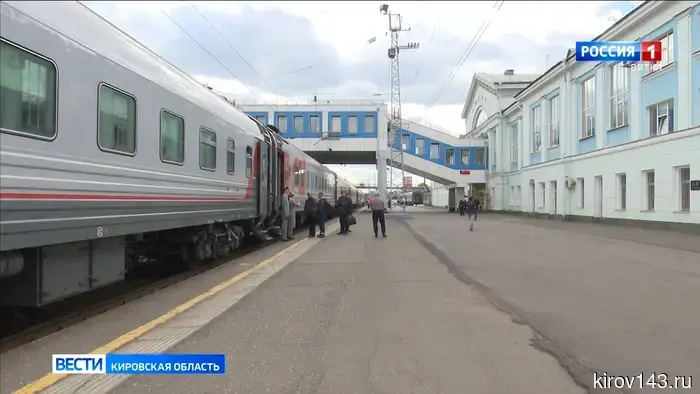 В Кировской области из-за сильных дождей была повреждена железная дорога.
Вследствие сильных дождей пострадала и железнодорожная сеть. 24 июня на участке между Зуевкой и Косой Горьковской железной дороги произошло подмывание путей. Для устранения ситуации выехал противоразмывной поезд для подсыпки балласта. Из-за этого произошли задержки нескольких пассажирских поездов. На данный
В Кировской области из-за сильных дождей была повреждена железная дорога.
Вследствие сильных дождей пострадала и железнодорожная сеть. 24 июня на участке между Зуевкой и Косой Горьковской железной дороги произошло подмывание путей. Для устранения ситуации выехал противоразмывной поезд для подсыпки балласта. Из-за этого произошли задержки нескольких пассажирских поездов. На данный
 Veterans of the Opalinsky district thanked Boris Vesnin for the "Good Harvest" campaign.
During a working trip to the Opalinsky municipal district, State Duma deputy and deputy director of the Uralchem branch Boris Vesnin met with representatives of the district's veterans' organization.
Veterans of the Opalinsky district thanked Boris Vesnin for the "Good Harvest" campaign.
During a working trip to the Opalinsky municipal district, State Duma deputy and deputy director of the Uralchem branch Boris Vesnin met with representatives of the district's veterans' organization.
 The Youth Council of the branch "KCHHK" held a patriotic quest.
The Youth Council of the branch "KCHHK" of JSC "OHC "Uralchem" organized a patriotic quest game "On the Roads of Memory," dedicated to the Day of Remembrance and Sorrow — the date marking the beginning of the Great Patriotic War.
The Youth Council of the branch "KCHHK" held a patriotic quest.
The Youth Council of the branch "KCHHK" of JSC "OHC "Uralchem" organized a patriotic quest game "On the Roads of Memory," dedicated to the Day of Remembrance and Sorrow — the date marking the beginning of the Great Patriotic War.
"The rise in fuel prices could quickly drive up inflation": experts on the market situation
Analysts have explained how the fuel crisis could affect the country's economic stability.