
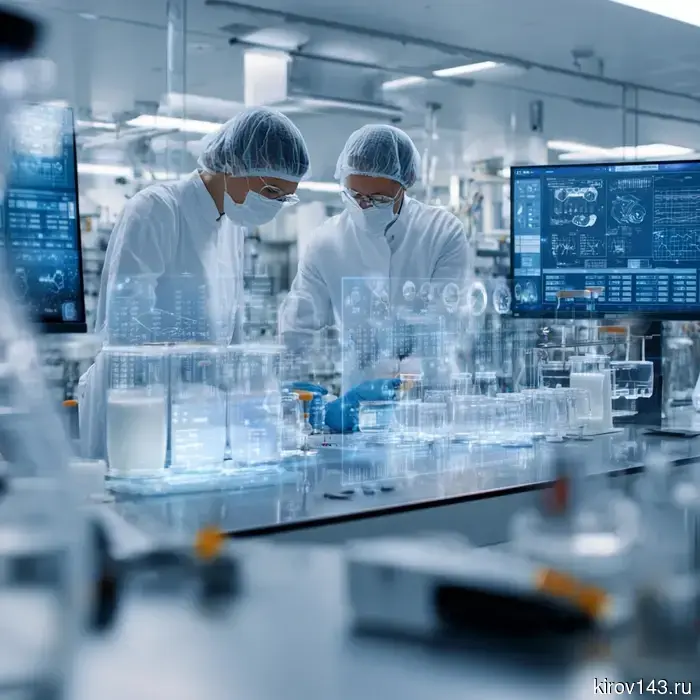
Medicines will be created 4 times faster: how AI has revolutionized pharmaceuticals
From Giggles to Reality
The development of artificial intelligence technologies is progressing at an astonishingly fast pace. As noted by Vadim Vitalievich Negrebetsky, the director of the Institute of Pharmacy and Medical Chemistry at Pirogov University, just a year ago many were skeptical about the prospects of AI in pharmaceuticals, but today "the fairy tale is becoming a reality."
Previously, creating an original drug required at least 10-15 years and nearly a billion dollars, but now there are examples of entering clinical trials in just a year and a half. At the same time, the costs—both material and human—have become incomparably lower.
Where AI is Already Helping
The most obvious application is the development of new molecules. But the field is not limited to this. Artificial intelligence is actively used to identify patterns when working with big data: searching for reliable information about drugs, systematizing clinical data on efficacy and safety.
Based on this data, decision support systems for physicians are developed. According to Vadim Vitalievich, AI allows doctors to "see the invisible." Analyzing millions of patient medical histories helps generate data for the development of innovative drugs. Personalized medicine is reaching a new level.
Economics: A Fourfold Reduction in Costs and a Twofold Reduction in Time
The pharmaceutical industry, as the expert explains, is not interested in creating "Aspirin_2"—a drug with only slightly greater efficacy but colossal development costs. The optimal path is to significantly increase the efficacy of drugs while simultaneously optimizing expenses.
Drugs based on "small molecules" have likely reached the limit of their effectiveness. They may still be in demand in areas of unmet need: Parkinson's and Alzheimer's diseases, cognitive disorders, anxiety-depressive disorders, and recovery after a stroke.
However, the main contribution of AI today is accelerating the initial stage of development, for example, "drawing" the initial lead molecule. All other stages (preclinical research and three phases of clinical trials for safety and efficacy) will still have to be passed "in vivo" by the drug candidate. But optimizing these stages, including clinical trial protocols, using machine learning and neural networks is quite feasible.
According to available data, a reduction in investments in drug development through the application of AI is expected to be at least fourfold, and the time to market is expected to be reduced by at least half.
Initial Results: 70 Drugs in the First Phase
By the end of last year, about 70 drugs worldwide, created using AI, entered the first phase of clinical trials.
This is a very good result; however, how many of them will pass safety and efficacy tests is still unclear. If we assume that the market entry percentage remains classic (around 12%), that is still not bad.
A More Tempting Niche: Genetic Engineering
According to the expert, an even more promising area for AI is not "small molecules," but genetic engineering methods. A recent example is the drug for Bechterew's disease "seniprutug" (an innovative development by Russian scientists), which is a recombinant human monoclonal antibody.
Here, AI can help create effective treatments for previously incurable diseases.
The Main Limitation: No Way Without Humans
Vadim Vitalievich emphasizes: even in the future, AI will not be able to independently create a drug ready for market release.
Without human involvement, everything that is governed by human consciousness will remain impossible: conducting experiments in the real world, verifying and interpreting the obtained data, conducting preclinical and clinical trials, regulatory studies, and much more.
Artificial intelligence is already radically accelerating and reducing the costs of the initial stages of drug development—fourfold in costs and twofold in time. It helps doctors see the invisible and process vast amounts of data. But clinical trials on humans have not been canceled, and the final decision still rests with humans.
Другие Новости Кирова (НЗК)
 Business horoscope: Cancers will showcase their talent, while Leos will have good luck with finances.
Astrologers revealed how the new workday will go for each zodiac sign.
Business horoscope: Cancers will showcase their talent, while Leos will have good luck with finances.
Astrologers revealed how the new workday will go for each zodiac sign.
 Пенсионеры из Кирова будут представлять свой регион на всероссийском чемпионате по компьютерным технологиям.
XVI Всероссийский чемпионат по компьютерному многоборью для пенсионеров состоится 25 июня в Рязани, сообщили в правительстве региона. В 2026 году мероприятие пройдет в смешанном формате: как в очном, так и в онлайн-режиме. Кировскую область будут представлять три участника: жители Кирова, поселка городского типа Тужа и...
Пенсионеры из Кирова будут представлять свой регион на всероссийском чемпионате по компьютерным технологиям.
XVI Всероссийский чемпионат по компьютерному многоборью для пенсионеров состоится 25 июня в Рязани, сообщили в правительстве региона. В 2026 году мероприятие пройдет в смешанном формате: как в очном, так и в онлайн-режиме. Кировскую область будут представлять три участника: жители Кирова, поселка городского типа Тужа и...
 In Kirovo-Chepetsk, a house was on fire, in Kirov — a summer cottage.
The Ministry of Emergency Situations reported on the latest fires and traffic accidents.
In Kirovo-Chepetsk, a house was on fire, in Kirov — a summer cottage.
The Ministry of Emergency Situations reported on the latest fires and traffic accidents.
 Business horoscope: Cancers will showcase their talent, while Leos will have good luck with finances.
Astrologers revealed how the new workday will go for each zodiac sign.
Business horoscope: Cancers will showcase their talent, while Leos will have good luck with finances.
Astrologers revealed how the new workday will go for each zodiac sign.
 Kirov residents shared where they dream of spending the perfect vacation.
Most residents of Kirov would prefer to spend their vacation in Russia, however, one in three dreams of a trip abroad.
Kirov residents shared where they dream of spending the perfect vacation.
Most residents of Kirov would prefer to spend their vacation in Russia, however, one in three dreams of a trip abroad.
 On the Day of Remembrance and Sorrow, a laying of flowers will take place in the Kirov region.
A minute of silence will also be announced.
On the Day of Remembrance and Sorrow, a laying of flowers will take place in the Kirov region.
A minute of silence will also be announced.
Medicines will be created 4 times faster: how AI has revolutionized pharmaceuticals
Not long ago, the development of a new original drug took 10 to 15 years and cost about a billion dollars. Today, thanks to artificial intelligence, the first clinical trials can begin in just a year and a half. An expert from Pirogov University explained where AI truly works wonders and where human involvement is indispensable.