
Chernobyl disaster: 40 years later. How it was and what the zone is like today.
What happened on the night of April 26
The cause of the disaster was not the experiment conducted by the station staff, but a fateful combination of circumstances, personnel errors, and design flaws of the RBMK-1000 reactor. In an attempt to test the operation of the turbo generators, the operators violated the regulations. The reactor's power dropped to nearly zero, and then they tried to raise it by withdrawing almost all control rods.
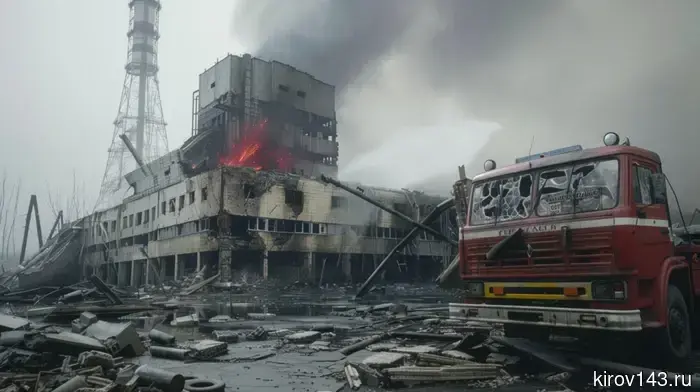
At 1:23:47, the emergency button AZ-5 was pressed. The control rods went down, but due to the graphite moderator, their insertion caused a brief, uncontrolled power surge. Two sequential explosions occurred. The 2000-ton reactor was completely destroyed, and its 1000-ton upper plate was blown into the air. The building of the fourth block ceased to exist.
The feat of the first liquidators
Immediately after the explosion, firefighting teams from Pripyat and Chernobyl arrived to extinguish the fire. The firefighters, many of whom had just woken up from the alarm signal, did not know that an invisible death surrounded them. They were not provided with dosimeters or radiation protection equipment. Nevertheless, they did the main thing – they prevented the fire from spreading to the neighboring third power unit. The flames were extinguished within a few hours.
Lieutenant Vladimir Pravik, the shift commander, and his comrades received doses that were fatal to humans. Almost all of them died from radiation sickness within the following month. These were the first, but by no means the last victims – during the liquidation of the consequences, dozens of people died, and hundreds of thousands received significant doses of radiation.
Evacuation of Pripyat and the creation of the exclusion zone
For 36 hours after the explosion, the residents of Pripyat, the town adjacent to the station, knew nothing about the real scale of the disaster. They saw the glow, but the authorities announced that everything was fine. Only on the afternoon of April 27 did an announcement about evacuation sound over the loudspeakers – supposedly for three days. At 14:00, buses began to arrive. People took documents, money, warm clothes, locked their apartments… and left their homes forever.
In just a few hours, about 115,000 people were evacuated from the 30-kilometer exclusion zone. The atomic city of Pripyat, which had a population of 47,500, including thousands of children, became deserted. Today it is a ghost town, rapidly being reclaimed by the forest.
Consequences for people and nature
The radioactive cloud, which rose to a height of up to 10 kilometers, covered vast territories of Belarus, Russia, Ukraine, and European countries. The most severe contamination affected the Gomel, Bryansk, and Kyiv regions. Hundreds of thousands of hectares of land were excluded from agriculture. Millions of people found themselves in the risk zone – among them, three groups are typically highlighted: liquidators, evacuees, and residents of contaminated areas.
The medical consequences are still assessed ambiguously. With the exception of acute radiation sickness among the first firefighters and some operators of the station, a direct link between most later diseases and Chernobyl has not been scientifically proven. However, the psychological trauma and socio-economic damage are colossal. The exclusion zone has become a symbol of human vulnerability.
The contribution of the Kirov region: numbers, fates, memory
Although the Kirov region was thousands of kilometers away from Chernobyl, its residents became some of those who, at the cost of their health, stopped the spread of radiation. Between 3,500 and 4,500 residents of Kirov participated in the liquidation of the consequences of the accident. According to the most accurate data, this is 3,984 people. Of these, 2,811 were military personnel called up from the reserve – just from one Nagorsk district, 4,500 people left.
More than 1,600 residents of the region were awarded state honors. Among them is Alexander Kudryavtsev, our fellow countryman, who on the fateful night of April 26, 1986, was among the 20 duty operators of the station. And Yuri Vershinin, a native of the village of Kostino in the Zuevsky district, was among the first liquidators to arrive at the epicenter of the disaster.
The price of this feat turned out to be unreasonably high. The tragedy claimed the lives of more than 1,500 residents of the Kirov region. Of the 3,500 participants from Kirov, 2,745 were affected, and 778 were recognized as disabled. Today, 40 years later, 572 participants in the liquidation live in Kirov itself. In remote areas, only a few remain – for example, in the Nagorsk district, as of 2020, only two were alive: Valery Ivanovich Kozlov and Vladimir Nikolayevich Perivakov.
The region continues to support those affected by radiation. More than 2,135 residents of the region (liquidators, disabled, evacuees) receive over 30 types of compensation and benefits. A monthly cash payment is received by 1,700 people. For 21 years, the public organization "Chernobyl Union" has been operating in the Kirov region, uniting 742 people. There is also a city organization – 341 participants. They work to preserve memory and assist their wards.
Every year in Kirov, solemn meetings and flower-laying ceremonies are held at the memorial to Kirov residents who were affected by Chernobyl, with the participation of the governor and representatives of the city authorities. "Lessons of Courage" are held in schools, and historical-documentary exhibitions dedicated to the feat of the liquidators are organized in libraries, such as in the Herzen Library.
The zone today: nature takes over
40 years later, the Chernobyl Reserve is a unique ecosystem. Thanks to the departure of people, rare species of animals have appeared here: moose, wild boars, lynxes, brown bears, as well as the legendary Chernobyl wolves. The radiation level in most places open for limited visits has fallen to safe values, but it is still prohibited to leave the ground and touch metal.
In 2016, a new sarcophagus "Shelter-2" was commissioned over the fourth block, which covered the old, deteriorating structure. This grand arch structure weighing 36,000 tons is supposed to provide protection for 100 years. However, the war has made its adjustments. In the spring of 2022, the zone found itself in the center of hostilities, creating new risks. Currently, tourist access is limited, and the fate of the sarcophagus and the scientific laboratories operating in the zone raises concerns.
Lessons for the world and memory
Chernobyl changed the world. It led to the tightening of nuclear standards across the planet, the closure of many old reactors, and the emergence of international conventions on rapid notification in the event of accidents. But it also showed how fragile our control over the atom is.
Today, April 26, mourning rallies are held in Russia, Belarus, and many other countries. In Moscow, liquidators and their family members lay flowers at the monuments to the Chernobyl heroes. The president and regional leaders remember those who, at the cost of their lives, stopped the spread of death. Eternal memory to the firefighters, military personnel, miners, builders – to all those to whom we owe that the catastrophe did not become global.
The tragedy of Chernobyl is not a page of history behind glass. It is a warning that must not be forgotten. Especially today, when the world is once again faced with the atomic threat – but now military.
Другие Новости Кирова (НЗК)
 The Ministry of Emergency Situations has published a weather warning.
Residents of the Kirov region have been warned about worsening weather.
The Ministry of Emergency Situations has published a weather warning.
Residents of the Kirov region have been warned about worsening weather.
 The road from Orichi to Korshik will be repaired only partially.
The work must take place in the summer.
The road from Orichi to Korshik will be repaired only partially.
The work must take place in the summer.
 Кировчанам напомнили о мерах предосторожности при нахождении оставленных без присмотра предметов.
Жителей Кировской области напоминают о правилах поведения при нахождении забытых или бесхозных предметов. К основным рекомендациям относится запрещение поднимать с земли бесхозные вещи, а также не брать в руки оставленные (забытые) предметы на скамейках, в транспорте, на улице, в магазинах и в других местах.
Кировчанам напомнили о мерах предосторожности при нахождении оставленных без присмотра предметов.
Жителей Кировской области напоминают о правилах поведения при нахождении забытых или бесхозных предметов. К основным рекомендациям относится запрещение поднимать с земли бесхозные вещи, а также не брать в руки оставленные (забытые) предметы на скамейках, в транспорте, на улице, в магазинах и в других местах.
 Кировцы получили награды на фестивале «Театрального Приволжья».
24 апреля в Государственном национальном театре Удмуртской Республики прошла торжественная церемония награждения победителей VII окружного Фестиваля детских и молодежных театральных коллективов «Театральное Приволжье», как сообщили в правительстве области. Победителей выбрали в различных номинациях.
Кировцы получили награды на фестивале «Театрального Приволжья».
24 апреля в Государственном национальном театре Удмуртской Республики прошла торжественная церемония награждения победителей VII окружного Фестиваля детских и молодежных театральных коллективов «Театральное Приволжье», как сообщили в правительстве области. Победителей выбрали в различных номинациях.
 Business horoscope: Capricorns are smiling at luck, while Pisces face unstable negotiations.
Astrologers revealed how the new working day will go for each zodiac sign.
Business horoscope: Capricorns are smiling at luck, while Pisces face unstable negotiations.
Astrologers revealed how the new working day will go for each zodiac sign.
 Muscovites will look at Kirov from the metro.
Local authorities have reached an agreement with the capital on the implementation of a new project.
Muscovites will look at Kirov from the metro.
Local authorities have reached an agreement with the capital on the implementation of a new project.
Chernobyl disaster: 40 years later. How it was and what the zone is like today.
On April 26, 1986, at 1:23 AM, the world was shaken by news that was initially impossible to comprehend: the explosion at the Chernobyl nuclear power plant. Four decades later, this tragedy remains a symbol of technological threat and human heroism. Today, on the 40th anniversary of the disaster, we remember the chronicles of events, the heroism of the liquidators, and the lessons that were never fully learned.