
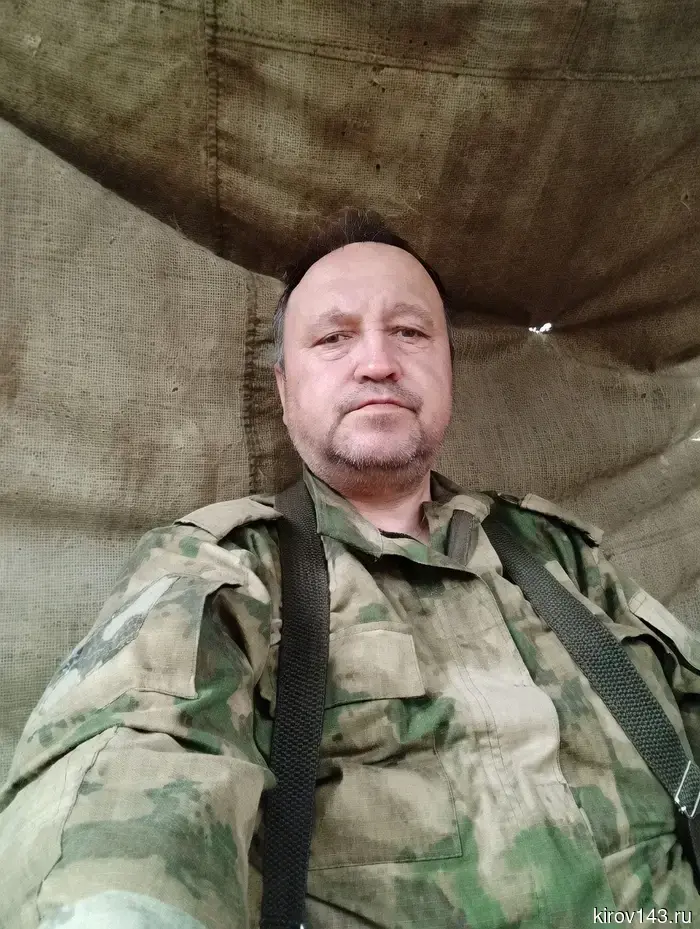
First throw: The SVO enters the Valenchuk district
The first candidate for district No. 106 has appeared on the primary portal — Ramil Khairulin, a native of Sosnovka in the Vyatskopolyansky district. A participant in the special military operation, a driver, and a graduate of VyatSU in 2016. Behind the concise lines of the questionnaire lies a biography that may prove to be a significant factor for the local political configuration.
Signals, Expectations, and the Rotation Scenario
In the regional political environment, the scenario of a possible renewal of representation for the 106th single-member district, which has long been associated with Oleg Valenchuk, has been consistently discussed over the past year. According to sources close to the regional political agenda, the head of the region, Alexander Sokolov, signaled the advisability of updating the candidate composition. In expert circles, this was interpreted as a guideline for rotation and a reduction in dependence on personalized electoral models.
Among the most likely candidates for replacement was the current deputy of the Legislative Assembly, Ravil Nurgaleev. The scenario of managed rotation seemed almost predetermined and implied a transfer of political representation. However, in recent months, this option has become irrelevant, prompting local politicians to consider strengthening Valenchuk, who was clearly dissatisfied with such a setup.
Who is Ramil Khairulin
Ramil Khairulin was born on August 29, 1974, in Sosnovka — a key point in the southern cluster of the district. He received higher education at Vyatka State University, graduating in 2016. His workplace is the Ministry of Defense of the Russian Federation, and his position is a driver. This is not a desk biography, but rather an experience associated with direct risk and involvement in ongoing events.
His biography lacks political experience; however, it includes what is gaining particular weight today: participation in combat operations and an organic connection to the territory.
The District of a Stable Model
District No. 106 (the southern part of the region — Vyatskopolyansky, Malmyzhsky, and Urzhumsky districts) has been associated with one name for almost two decades — Oleg Valenchuk. A deputy of the State Duma for six convocations and the chairman of the Union of Gardeners of Russia, he has built a stable model of influence here: close work with municipalities, support for gardening associations, high personal recognition, and the absence of significant intra-party competition.
The emergence of an alternative candidacy changes the usual logic of the process. In this case, it is not about a "technical" candidate. The status of a participant in the special military operation gives Khairulin's candidacy weight that is difficult to neutralize through backroom mechanisms.
At the same time, experts allow for a more pragmatic interpretation of what is happening. It is possible that the nomination may also serve a technical function, forming a competitive contour for the primary procedure. However, in this case, such a version has limitations. The status of a participant in the special military operation significantly increases the public weight of the candidate and reduces the manageability of such scenarios, making them less predictable compared to classic "technical" applications.
In this sense, Khairulin's emergence may benefit several parties: both those interested in updating the configuration of the district and those who want to demonstrate the competitiveness of the procedure without direct conflict within the system.
Changing the Logic
Khairulin's emergence forces a reconsideration of previously discussed scenarios. If we proceed from earlier signals about the need for renewal and the proposed candidacy of Nurgaleev, the current situation indicates a different approach — not a soft rotation within the established system, but a more public and symbolically loaded renewal.
Khairulin is not embedded in the existing elite hierarchy and lacks legislative experience. However, his position is strengthened by a factor that today holds high political significance — the status of a participant in the special military operation, complemented by local identity.
In this sense, it may not be so much about replacing one deputy with another, but rather about adjusting the principle of forming the candidate pool.
Trend: Participants of the Special Military Operation in Politics
The year 2026 marks a trend: participants and veterans of the special military operation are increasingly being nominated for elected positions at various levels. For "United Russia," this is both a resource and a challenge. On one hand, there is a high level of public trust in such candidates. On the other hand, there is a factor that can influence previously established management configurations.
In the Kirov region, Khairulin is currently the first such candidate for the State Duma elections; however, in the context of nationwide dynamics, his emergence appears to be more the beginning of a process than an exception.
Development Options
Before the registration deadline (April 30), several scenarios are possible:
Direct competition: both candidates (and possibly more) reach the preliminary voting stage. This is the most public scenario, where the result will depend on the ratio of accumulated political resources and the effect of the "new candidate."
Backroom settlement: an attempt to steer the situation into a manageable course through negotiations. However, given the candidate's status, such an option carries reputational risks.
Compromise configuration: redistribution of roles (for example, the current deputy moving to the federal list) while maintaining a balance of interests.
Voluntary withdrawal: the least likely but most cautious scenario — the current deputy's independent decision to transfer the district to the new candidate.
What This Means
The emergence of a participant in the special military operation in a district that has long been perceived as predictable indicates a transformation of familiar mechanisms. The system is facing new factors, and previous agreements are proving to be less stable.
Khairulin's biography — local origin, education, service — makes him both embedded in the regional context and a bearer of a different political logic. For other single-member districts in the region, this is a signal: even within formally stable configurations, changes are possible.
The 2026 campaign in the Kirov region, at least at the federal level, ceases to be a formal procedure.
Другие Новости Кирова (НЗК)
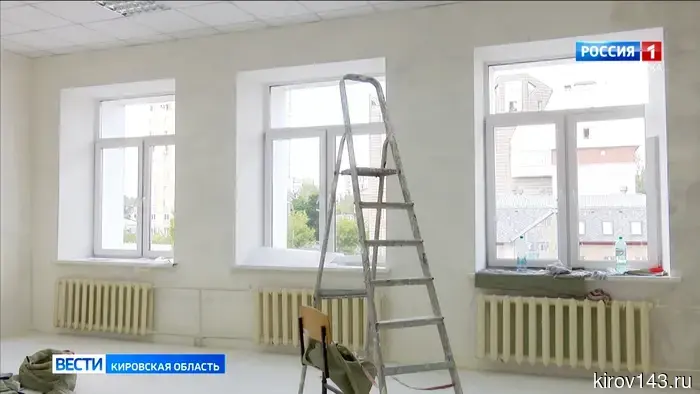 В Кировской области в этом году запланировано отремонтировать 34 школы.
В этом году в Кировской области запланирован ремонт 34 учебных заведений. Наш регион принимает участие в крупной федеральной программе по капитальному ремонту зданий образовательных учреждений. В этом году сумма финансирования превышает 1,5 млрд рублей. В 29 школах уже идут работы по капитальному ремонту.
В Кировской области в этом году запланировано отремонтировать 34 школы.
В этом году в Кировской области запланирован ремонт 34 учебных заведений. Наш регион принимает участие в крупной федеральной программе по капитальному ремонту зданий образовательных учреждений. В этом году сумма финансирования превышает 1,5 млрд рублей. В 29 школах уже идут работы по капитальному ремонту.
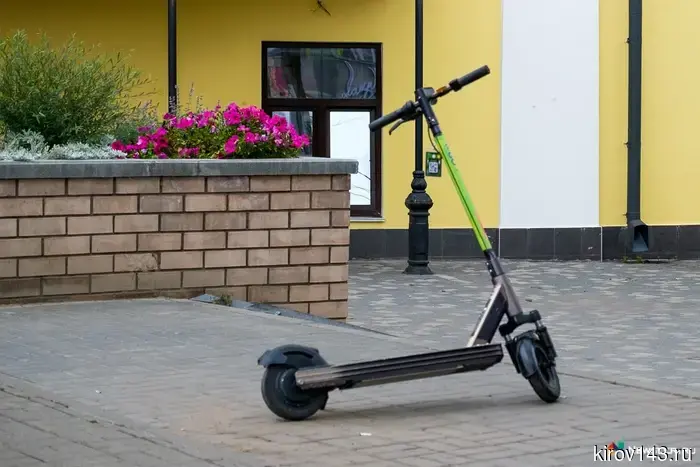 In Russia, a GOST for electric scooter numbers has been approved.
A standard for state registration plates for individual mobility devices (IMD) has officially appeared in Russia. The document establishes the appearance of the license plates, which will soon become mandatory for private and rental electric scooters.
In Russia, a GOST for electric scooter numbers has been approved.
A standard for state registration plates for individual mobility devices (IMD) has officially appeared in Russia. The document establishes the appearance of the license plates, which will soon become mandatory for private and rental electric scooters.
 Соколов попросил Рогожкина узнать цены на яйца в Кировской области.
Соколов обратился к Рогожкину с просьбой проверить стоимость яиц в Кировском регионе.
Соколов попросил Рогожкина узнать цены на яйца в Кировской области.
Соколов обратился к Рогожкину с просьбой проверить стоимость яиц в Кировском регионе.
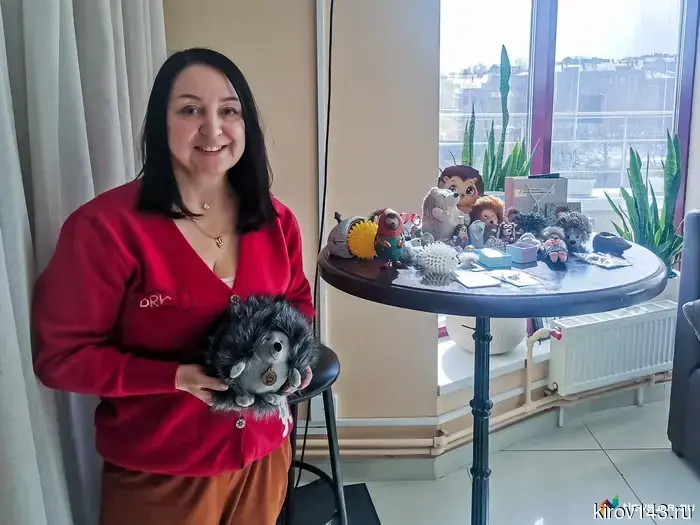 Morozova is searching for hedgehogs all over Russia.
On Saturday, March 28, the first festival "Hedgehog Fest: Familiar Stranger" took place at the Family Center "Vyatka Generation" in the region. The organizer was Irina Morozova, the deputy chairwoman of the Legislative Assembly of the Kirov region — a person who has been collecting everything related to hedgehogs for over ten years.
Morozova is searching for hedgehogs all over Russia.
On Saturday, March 28, the first festival "Hedgehog Fest: Familiar Stranger" took place at the Family Center "Vyatka Generation" in the region. The organizer was Irina Morozova, the deputy chairwoman of the Legislative Assembly of the Kirov region — a person who has been collecting everything related to hedgehogs for over ten years.
 Gemini will "pull off" a number, while Cancer will earn a reputation as a bore.
Astrologers revealed what to expect from each zodiac sign on the second working day of the current week.
Gemini will "pull off" a number, while Cancer will earn a reputation as a bore.
Astrologers revealed what to expect from each zodiac sign on the second working day of the current week.
 Version: Does Sosnovka live by the law of Kushchevka?
Residents of the Vyatskopolyansky town reported on another "lawlessness of the Sosnovsky militants" on the evening of March 28.
Version: Does Sosnovka live by the law of Kushchevka?
Residents of the Vyatskopolyansky town reported on another "lawlessness of the Sosnovsky militants" on the evening of March 28.
First throw: The SVO enters the Valenchuk district
The preliminary voting procedure of "United Russia" for the State Duma elections in the Kirov region is just beginning, but it has already been marked by an event that could change the usual power configuration in one of the two single-member districts of the region — the very ones where competition has long remained predictable.